Wednesday, 15 December 2021

#HistoricalFiction author, Dr. Christopher D. Stanley , is talking about the Mighty Goddesses of Asia Minor #History @aslavesstory


A Rooster for Asklepios 
(A Slave's Story Trilogy, Book 1)
By Christopher D. Stanley
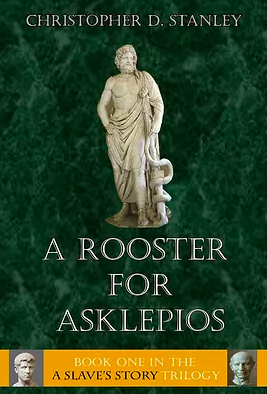


Publication Date: May 23rd 2020
 Publisher: Amelia Books
 Page Length: 522 Pages 
 Genre: Historical Fiction

Marcus, a slave in the household of Lucius Coelius Felix, enjoys a better life than most slaves (and many free citizens) as the secretary and accountant of a wealthy aristocrat.  His master is rising in the civic life of the Roman colony of Antioch-near-Pisidia (central Turkey), and his responsibilities and income are growing as well. If this continues, he could soon earn enough to buy his freedom, set up a small business, and even marry.  

Then misfortune strikes, and his master falls into a deep depression that is exacerbated by a nagging illness that his physician is unable to cure.  The future looks bleak until the physician receives a dream from the healing god Asklepios calling Lucius to travel hundreds of miles across western Asia Minor to his sanctuary at Pergamon for treatment and, he hopes, a cure.

Accompanied by Marcus and his new wife Selena, Lucius embarks on a long and eventful journey in which both master and slave encounter people and ideas that challenge long-held beliefs about themselves, their society, and the world around them.  Values are questioned, loyalties tested, and identities transformed in a story that brings to life a corner of the Roman empire that has been neglected by previous storytellers.


Women Rule! Mighty Goddesses of Asia Minor
By Dr. Christopher D. Stanley

All three book titles in my A Slave’s Story historical fiction trilogy include the name of a male Greek or Roman deity who was known for his power.  
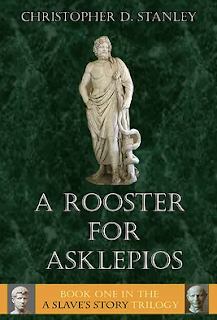
Book One (A Rooster for Asklepios) honors the Greek god of healing who was one of the most beloved deities of the Greco-Roman world because he used his power to restore health to those in need.  He plays a vital role in my story as my characters make a life-changing journey across Asia Minor to seek healing at one of his temples.

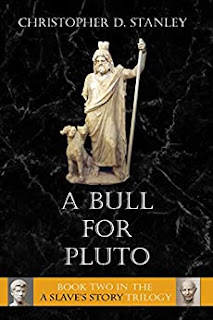
Book Two (A Bull for Pluto) employs the Roman
name for the lord of the underworld, a god so fearsome that people hardly dared to pronounce his name.  A crucial incident in my story takes place at a festival given in his honor at the spa city of Hierapolis in west central Asia Minor, a site that many people regarded as the entrance to the underworld.  Life hangs in the balance.
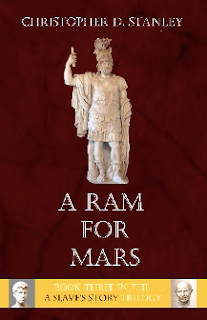
Book Three (A Ram for Mars) invokes the Roman deity of war and conquest, the epitome of male valor and destructive power.  His presence hovers in the background as my story shifts from Asia Minor to the land of Israel in the years leading up to the Jewish Revolt against the Romans in 66-73 AD.  Opposing him is another god of war, the God of the Bible, the Lord of Hosts, whom the Jewish rebels invoke on their side.  My story follows some very ordinary people who are caught in the middle of this epic conflict.

Despite these titles, male deities are not the only ones who exercise power in my novels.  Two powerful goddesses, Artemis and Cybele, also receive significant attention at various points in my story.  Both embodied the primal forces of life and nature, making them more powerful than any male deity to the people of this region.  Both had deep roots in the history and culture of Asia Minor where the first two books of my trilogy take place.  


Long before the coming of the Greeks and Romans, the people of Asia Minor (modern Turkey) honored powerful earth goddesses as a central element of their religion.  The oldest known image of a goddess from this region dates to 14,000 BCE.  The two images above, which date to around 6000 BCE, were found at a site in south central Turkey called Çatalhöyük.  Comparisons with other cultures have led most interpreters to interpret them as fertility goddesses, but this idea has been contested in recent years.  Their corpulent forms more likely symbolized prosperity in an era when food security could not be taken for granted.  Note the feline figures on either side of the woman on the right—they will reappear in later images of goddesses from the region. 
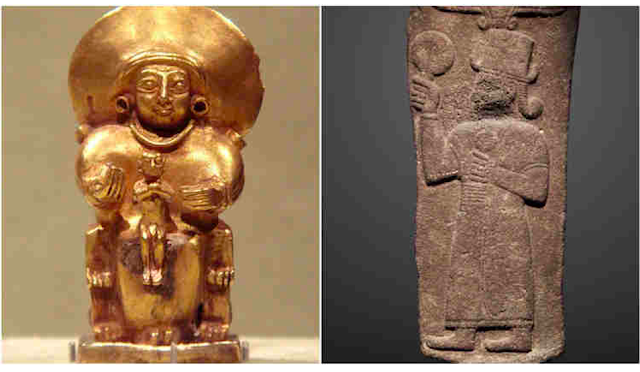

The period of the Hitttes (2nd millennium BC) introduced to the historical record an influential category of ruler goddesses.  These goddesses did not rule alone—they were part of a broader pantheon of deities, and most were consorts of male deities.  But their duties extended much farther than fertility.  The images above show the sun goddess of Arinna, who during the Old Hittite era was the chief deity of the state.  The figure on the right is the goddess Kubaba, who was originally a human queen in Mesopotamia but over time became the chief goddess of the neo-Hittite state.  From this era forward, ruler goddesses played a central role in the religious life of Asia Minor.
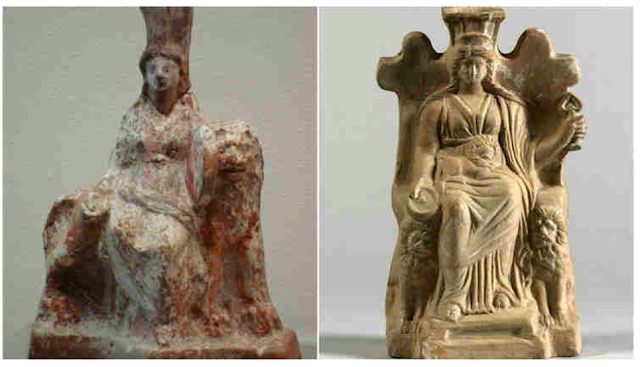

In the 1st millennium BC, the goddess Kybele (or Cybele), whose origins can be traced to the region of Phrygia in central Turkey, emerged as the preeminent deity of Asia Minor.  Her name may have been derived from the earlier Hittite goddess Kubaba, but her traits and powers were much broader that hers.  She embodied in herself all of the powers of wild nature, ruling over both animals and humans.  She is usually portrayed seated on a throne and wearing a turreted crown, with lions on either side or pulling her in a chariot, as shown in the images above.  All of these emblems symbolized authority, both divine and human. 
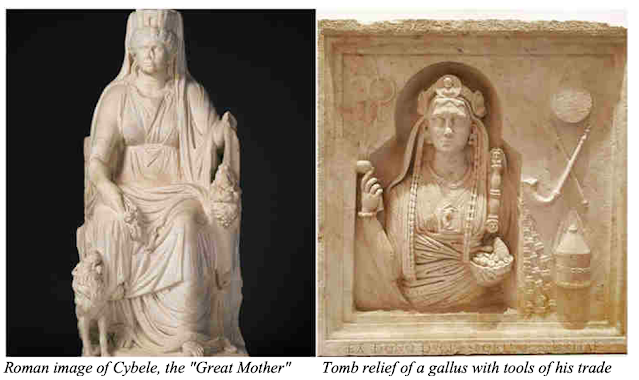

Temples of Kybele could be found all over Asia Minor by the middle of the 1st millennium BC, and in many other places as well, including Athens.  She was also served by wandering priests called galli who carried her statue around with them and engaged in frenzied public rituals that involved music and dancing and culminated with one or more of them castrating themselves as a final act of dedication.  The Romans were disgusted by these bizarre rituals, but they were so impressed with Kybele's power that they conscripted her to assist them in their war against Carthage, erecting a temple for her in Rome in 191 BCE.  She was the first non-Roman goddess to be worshipped in this way in Rome. 
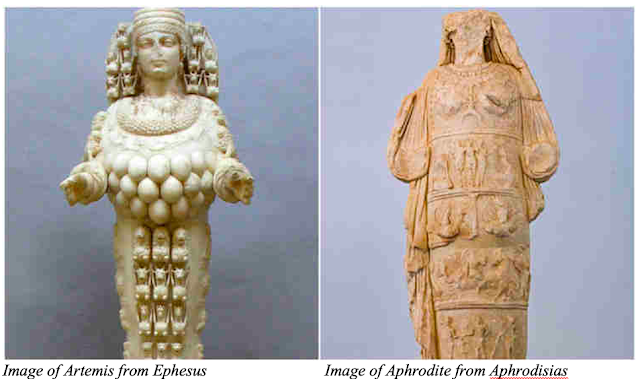

As Greeks and Romans came into contact with Kybele and her powerful reputation, they began to assimilate her with their own goddesses in both appearance and powers.  The image on the left is the famous cult statue of Artemis from her temple near Ephesus.  In Greek myth and sculpture, Artemis is a huntress who is shown running with flowing robes in company with wild animals.  This image is nothing like that.  The same is true for the statue of Aphrodite on the right, which is vastly different from the standard Greek image of her as a voluptuous nude.  Both include elements commonly associated with Kybele, especially the wild animals on their garments and the turreted crown.  Both were also worshiped as the patron deity and protector of their cities, following the pattern of Kybele and other ancient goddesses of Asia Minor.

Both Kybele and Artemis appear in the first two books of my A Slave's Story trilogy.  Book One describes a visit to the temple of Artemis at Ephesus, where my characters tour the site, learn about its history, and present an offering to the goddess seeking her favor on their journey.  Book Two depicts a festival for Kybele, Apollo, and Pluto that takes place in Hierapolis, a city famed for its healing springs.  The story includes two accounts of rituals performed by the priests of Kybele, the galli, that are so bizarre that modern people find them hard to comprehend.  But they really happened!  You have to read the books to find out what they did.

50% off Book One for a Limited Time Only
(15th - 30th December 2021)
Including #Kindle and #Paperback

Book Two


CHRISTOPHER D. STANLEY is a social and religious historian who studies and writes about early Christianity and the Greco-Roman world.  He recently retired as a professor at St. Bonaventure University in western New York.  He has written or edited six books and dozens of professional articles on early Christian texts and history and presents papers regularly at conferences around the world.  The trilogy A Slave's Story, which grew out of his historical research on first-century Asia Minor, is his first work of fiction.  He is currently writing an academic book about healing practices in the Greco-Roman world, a subject that plays a central role in his trilogy. 
 
Connect with Christopher:


Saturnalia: Pagan Rome’s Jolly Holiday by Brook Allen #History #AncientRome #Saturnalia @1BrookAllen

 Saturnalia: Pagan Rome’s

Jolly Holiday
By Brook Allen

As much as I love Christmas, my novels are set in pre-Christian Rome. So much for wishing Marc Antony a Merry Christmas! But Romans had plenty of festivals—times of celebrations, visiting temples, and making religious sacrifices. And sometimes, their festivals had nothing to do with religion at all, but honored birthdays, triumphs, or other ostentatious celebrations.
So what exactly did the Romans celebrate during the month of December? In a useful compilation of facts on Roman life, compiled by Lesley and Roy A. Adkins, the Handbook to Life in Ancient Rome includes a fantastic listing of festivals celebrated annually by the Romans. In December alone, there were at least fourteen holidays.
One of them was Saturnalia.
To the Romans, Saturnalia was considered to be one of the feriae stativae—festivals given a fixed date on the calendar. Celebrated originally on December 17th, it was a major festival, probably observed all over the Empire. It’s believed that by the end of the Republic, Antony and family would have been celebrating it for more than just one day. The party was extended from December 17th thru 23rd. Originally, dedicated to the deity Saturn, it celebrated the sowing of seeds.
How was it celebrated?
In most intriguing ways! Naturally, it began with sacrifices and offerings at the Temple of Saturn, the remains of which are still in the western part of the Forum Romanum. Considered to be a “jolly” sort of festival, slaves were allowed to temporarily be “free”. In fact, social mores were completely inverted, for all servants in a household dined before their owners and were even allowed to act “insolently”. This even included slaves dressing as their masters—probably using their very clothes. This is all recorded by ancient sources (since I couldn’t make this stuff up!). However, because of the Spartacan revolt at the end of the 1st century BC, I chose to depict this practice as frowned upon by some in my book, Antonius: Son of Rome.


Saturnalia was also a time of gift-exchanging and the usage of wax candles. In what context these items were given or used isn’t necessarily clear. Typically, oil lamps were used for lighting households, so candles may have been used simply for their loveliness, adding ambience to the holiday, much like today. Or, perhaps they were used in the religious part of the festival’s observance
Like me, you’re probably thinking that Saturnalia sounds an awful lot like Christmas, save for it being a pagan festival. Well, you’re right. It was replaced by Christmas, so to keep disgruntled non-Christians as happy as possible, customs like gift-giving, the use of candles, and merry-making remained. The date changed only slightly. A late-Imperial cult dedicated to the deity Sol Invictus celebrated the winter solstice on December 25th, according to the Julian calendar. This pagan event was also discontinued, but since it was so close to the dates of Saturnalia, the Christian holiday of “Christmas” was given that date, which has continued to the present.
Therefore, I’ll wish everyone a Merry Christmas and use the words of the Roman poet Catullus (14.15), to describe his festival of Saturnalia, wishing all of my readers “the best of days”!


Antonius: Son of Rome

By Brook Allen


For over two-thousand years, Marcus Antonius—Marc Antony—has been one of history’s most controversial men. His story was buried with him and written by his enemies. Now his entire saga is revealed in a compelling trilogy by Brook Allen.

After young Marcus Antonius’s father dies in disgrace, he yearns to restore his family’s honor during the final days of Rome’s dying Republic. Marcus is rugged, handsome, and owns abundant military talent, but upon entering manhood, he falls prey to the excesses of a violent society. His whoring, gambling, and drinking eventually reap dire consequences. Through a series of personal tragedies, Marcus must come into his own through blood, blades, and death. Once he finally earns a military commission, he faces an uphill battle to earn the respect and admiration of soldiers, proconsuls, and kings. Desperate to redeem his name and carve a legacy for himself, he refuses to let warring rebels, scheming politicians, or even an alluring young Egyptian princess.


Brook Allen


Brook Allen is a Music Educator in a rural community near Roanoke, VA. Aside from her regular classes, she teaches two ensembles, a Chorus and Recorder Consort. Born in Salt Lake City, UT, Brook was raised in Omaha, Nebraska and has lived all over the U.S., from the Pacific Northwest, all the way down to Florida. She graduated with a B.A. in Music Education and has a M. A. in Liberal Studies, with an emphasis on Roman History. Brook is happily married and has two energetic Labrador Retrievers. Voraciously active, she cycles, hikes, and loves to travel.
Connect with Brook: Website • Twitter • Facebook.

Tuesday, 14 December 2021

Blog Tour: Bird in a Snare (The Lord Hani Mysteries, Book 1) by N.L. Holmes #HistoricalFiction #HistoricalMystery #BlogTour #CoffeePotBookClub @nlholmesbooks


Join The Coffee Pot Book Club on tour with…

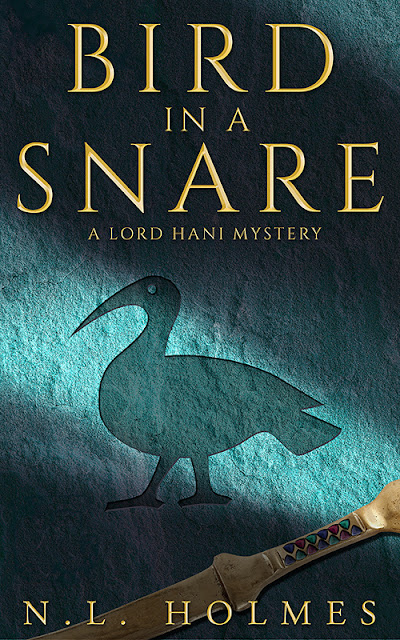
Bird in a Snare 
(The Lord Hani Mysteries, Book 1)
By N.L. Holmes


May 16th – May 27th 2022

Publication Date: 21st March 2020
Publisher: WayBack Press
Page Length: 425 Pages
Genre: Historical Mystery

When Hani, an Egyptian diplomat under Akhenaten, is sent to investigate the murder of a useful bandit leader in Syria, he encounters corruption, tangled relationships, and yet more murder. His investigation is complicated by the new king’s religious reforms, which have struck Hani’s own family to the core. Hani’s mission is to amass enough evidence for his superiors to prosecute the wrongdoers despite the king’s protection—but not just every superior can be trusted. And maybe not even the king! Winner of the 2020 Geoffrey Chaucer Award for historical fiction before 1750.

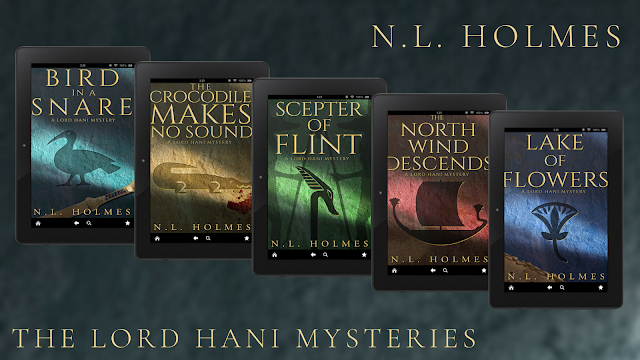
Grab the series:


Bird in a Snare • The Crocodile Makes No Sound • Scepter of Flint • The North Wind Descends • Lake of Flowers


N.L. Holmes


N.L. Holmes is the pen name of a professional archaeologist who received her doctorate from Bryn Mawr College. She has excavated in Greece and in Israel and taught ancient history and humanities at the university level for many years. She has always had a passion for books, and in childhood, she and her cousin (also a writer today) used to write stories for fun.

Website • Twitter • Facebook • LinkedIn • Instagram • Pinterest • BookBub • Amazon Author Page • Goodreads


Tour Schedule


Discover the inspiration behind the late George H. Wittman's fabulous novel - There Was a Time @Casemate_UK


There Was a Time 

By George H. Wittman


Publication Date: 28th November 2021
Publisher: Casemate UK
Page Length: 312 Pages
Genre: Espionage Thriller

It is the summer of 1945, the last and very dangerous days of World War II. The Office of Strategic Services is in close, cooperative contact with Ho Chi Minh and the fighting cadre of the Viet Minh, working against the Japanese. In the closing months of the war, the OSS parachute a team of special operations soldiers into Tonkin, northern Viet Nam. Based on the little-known true story of American and Viet Minh collaboration in 1945, this novel challenges the later-accepted dogma of both those supporting and those opposing the American role in the Viet Nam conflict.


It’s not unusual for there to be a story behind the story with fiction, but with “fact-based military fiction” as my Dad described his book, how much of that origin story can actually be told?

My father, the late George H. Wittman, was often described as a “Renaissance man”. It was an accurate description, as he wrote both fiction and nonfiction prolifically. He had an encyclopaedic knowledge of history and international affairs. He was an expert analyst with a lifetime of highly specialised on-the-ground expertise. He was a brilliant raconteur – a natural storyteller and will always remain the guy who was able to make me laugh more than anyone in the world, He was also an intelligence officer. 


I’m allowed to say that now, as the statement sits in the Author’s Note at the beginning of “There Was a Time” published just eight months after his passing. In keeping with what has become family tradition, I can let that statement stand, but not much more. 

My dad grew up on Army bases around the United States and was directly inspired by his father Col. George H. Wittman Sr. who landed on Omaha Beach on D-day Plus 6 and was awarded the French Legion d’ Honneur, Bronze Star, Army Commander Ribbon, 2 Croix de Guerre with Palm and 2 Battle Stars in the European Theatre. Dad joined the Army reserve in the fall of 1950 with the intention of working towards his commission. He was instead recruited into intelligence work. As his career developed, he undertook extensive sensitive assignments across the world. 


In his Author’s Note, he explains his relationship to the story; 

“I was assigned to the Indochina Branch after returning from Europe on my first assignment as an intelligence officer. I was supposed to go directly to the Far East in the summer of 1954 but was assigned to the Vietnam desk and subsequently the newly created Cambodia/Laos desk. About a year later, I went out to the field in covert operations for the Indochina Branch. Not once did I hear from official sources of the extensive contact that Office of Strategic Services (OSS) had had with Ho Chi Minh and other leaders of the Viet Minh. I learned about that years later. It was a matter never discussed during the 1950s and never taken advantage of in the 1960s.”

My siblings and I had always been instructed to say “Foreign Affairs Analyst” should anyone ask what our father did. We didn’t know much beyond that anyway, having been kept in the dark as much as possible. In seventh grade, my Social Studies teacher went around the room asking each student to tell the class what their father did. “Foreign Affairs Analyst” I mumbled. “Oh, and what is that - what does he do at work?” Silence. “So he’s like a doctor – A psychoanalyst? I nodded no, then spluttered “well, um…I mean…uh, yes. I guess…” realising I shouldn’t and likely couldn’t say any more. I was massively relieved to leave it at that as she moved on to the next kid, whose dad worked for the Post Office. 

It was only in later years that Dad began to use the phrase “intelligence officer” in the bylines or brief biographies that followed the innumerable expert and insightful weekly articles on a vast array of international topics and events that he wrote for thirteen years for “The American Spectator” and later for “The Washington Times” and “AND Magazine”, among others. And then only when the subject of the article fully warranted it. 

There Was a Time is not autobiographical as such. It is based directly on the stories, exploits and information shared with my father by the people directly involved in the activities of the OSS in Vietnam and their contact with Ho Chi Minh and the Viet Minh during the spring and summer of 1945. Dad’s friendship with these men - and the stories - continued to be shared down the decades that followed. 


However, I certainly recognise many aspects of the various characters’ inner journeys, the relationships between them, and the situations and struggles as stories my father may well have fervently wished to tell – perhaps even from first-hand experience. 

But he was far too legitimate an artist to simply write a thinly disguised autobiography. As fascinating a story as that surely would have been, it was one he had refused all this life to write down literally or in full – though some suggested he should. 

Agreed by many colleagues and foreign correspondents such as David Halberstam, Donald Wise, John Bulloch and John Tiffin, to name just a few, as the most ethical of men – and often described as a true American patriot, even a hero by some, my father also steadfastly resisted any political allegiance throughout his life. 

Despite the secrecy, he did have just a few stories he loved to tell us when we had matured enough to appreciate them. One involved a nondescript briefcase, expertly pilfered from his room when he was staying at a hotel overseas. It had contained nothing more than a box of very nice cigars and, hidden in a secret compartment, a report on “The Effects of Methane Gas in Lake Kivu”. This document had nothing to do with the business at hand. He’d recount how he was still angry at the loss of those nice cigars – but delighted at the thought of someone earnestly poring over, perhaps even trying to decode the substantial Lake Kivu Methane report in search of non-existent covert meaning. 

I was fortunate to have had so many amazing conversations, indeed heated debates with him down the years – as we did not always hold the same views. Sometimes he would win the argument with a wry smile; “Just read my stuff!” I had that emblazoned on a t-shirt for him one Christmas. 

Now he is there within the lines, or perhaps between the lines of There Was a Time. Just read his stuff. 

And to those guys still working hard on decoding “The Effects of Methane Gas in Lake Kivu”…I think you can stop now. 


The sound of heavy fire reverberated through the stone walls of the church. A small group of men dressed in traditional, working-class, civilian clothes huddled against the protective sides of the ancient walls. Each man was wrapped with bandoliers of ammunition and carried a rifle. Some had German “potato masher” grenades attached to their belts. They had made their way down from the Vosges Mountains to a small town southeast of Nancy as soon as they had heard the Americans were close. The Germans still put up a serious defense as they withdrew in order. This group of maquis eagerly looked forward to greeting their liberators. It had been a long and bloody fight between the elusive maquisards and the relentless Germans. No quarter given—none asked. The American tanks had to be just a few blocks away. The tallest of the men, speaking French with an unmistakable American accent, shouted above the din of the exploding tank shells that everyone should stay where they were. The old church shook from the impact of the firing on nearby buildings. The tall, gaunt American looked around the doorway to see exactly where the tanks were. They could all hear the rumble and metallic grinding of gears in between the noise of the detonations. One of the maquisards, an older man with a large grey mustache typical of the region, disregarding the advice of the American, dashed around him with a white flag made of a dingy grey scarf. The old man was oblivious to the voices screaming at him as he joyously jumped up and down with the rag attached to his rifle. A Sherman tank turned the corner. The machine gun mounted on the turret sprayed down the street as the gunner swept all moving objects in range. The old man died instantly as the tank rolled on, unmindful of what had just happened. The gunner thought he was taking fire from one of the roofs and directed his weapon upwards. Another tank followed and blew away the entire tile roof. The little town was completely “liberated” within the next 15 minutes. 2 Slowly townspeople appeared from the rubble of their destroyed homes and the cellars of those left standing. They cheered the infantry that followed the tanks. No one blamed the Americans for what had happened to their town. They were liberated now and that was all that mattered. The American dragged the body of the old man to the side of the road and, with the help of one of the maquisards, carried the corpse back into the church. No one said anything. The rifle with the scarf still attached was laid by the old man’s side. The American untied the scarf and slipped it around the dead man’s neck. They all crossed themselves—even the American, who wasn’t even Catholic. Their war had ended.


Purchase your copy of 

There Was a Time 

at your favourite online bookstore:


George H. Wittman served in the US Army during and after the Korean War and, in the following decades, became intimately involved in national security, global intelligence matters and international business. A veteran of forty-five years of international security operations and analysis, he undertook extensive sensitive assignments across the globe. He served as founding chairman of the National Institute for Public Policy, lectured periodically at the FBI Academy in Quantico, VA, and had a consulting relationship with the FBI's New York field office. Above all, he viewed and presented himself as an American patriot, resisting political affiliation and committed to what he believed was in the best interest of the nation.


Christmas in the time of the Vikings by Mercedes Rochelle #Christmas #History #Vikings @authorrochelle


Christmas in the time of the 

Vikings


By Mercedes Rochelle
Yule celebrations are Pagan in origin and came from the Germanic countries. They were alive and well in the Nordic lands, and were most likely brought over to Anglo-Saxon England with the Viking settlers. Eventually, the midwinter celebrations merged with the Christian festival of Christmastide, better known as the 12 Days of Christmas. I think we would recognize many of their festivities, although some of them were dedicated to Odin!

Since the Yule (or Jul) took place around the Solstice, the shortest day of the year, there is a certain element of celebrating the return of the light. It is said that the name Yule is derived from the Old Norse HJOL, meaning ‘wheel,’ to identify the moment when the wheel of the year is at its lowest point, ready to rise again. But it was also thought that in this time of year, the spirits of the dead most commonly crossed over into the human realm. It is thought that many of the Yuletide customs were an attempt to protect the household against hostile supernatural influences. On the other hand, it is also said that ancestors came back during this season, and sometimes food was left out for them so they would help promote a good harvest the following year. Some of the spirits were benevolent—but not all.

Odin riding Sleipnir. From the 18th century Icelandic manuscript. Source, Wikipedia.

One night stood out from the others—the 24th of December. This is when the children filled their shoes with straw, carrots and sugar lumps and set them out by the fire to feed Odin's flying eight-legged horse Sleipnir as the God led the Wild Hunt—the host of the restless dead—through the darkness. In return, Odin would leave the children small gifts and sweets as a reward. He was even known to slide down the chimney! Or fire hole, as the case may be.


Many tales were told of the Wild Hunt. Because winter nights were often stormy and turbulent, Odin was most likely to be heard then, raging and howling, riding to collect the fallen, whether they be living or recently departed. People—especially children—were warned to stay indoors. It was a terrible thing to witness the Wild Hunt; rumors abounded that people seeing the Wild Hunt might be abducted to the underworld or to the fairy kingdom—or even killed. A gift—or rather, a sacrifice—was advised, to thank Odin for taking care of the family’s recently deceased. In 1673, Johannes Scheffer (The History of Lapland) wrote “All the Bits they have preserved for these two Days, they put in a small Chest made of the Bark of Birch, in the shape of a Boat, with its Sails and Oars; they pour also some of the Fat of the Broth upon it, and thus hang it on a Tree, about a Bow Shot distant from the backside of their Huts”. Perhaps this represented the practice of ship burials, though no one really knows the exact purpose of this ritual.

The Wild Hunt by Johan Wilhelm Cordes, Museum Behnhaus Drägerhaus, Lubeck, Germany (Source, Wikipedia).

Yule is a time for feasting, dancing, and family. The traditional food of the Yule was Boar, an animal sacred to Freyr, the Norse God of Yule and fertility. This was probably the origin of the Boar's Head presented at later Christmas feasts. Then we have the Yule Log. The largest ash—the wood of Yggdrasil—log was brought inside so that ritual runes could be carved onto it, calling on the gods to protect one and all from ill-fortune. Burning the Yule log was thought to give power to the sun and bring warmth again to the land. The carved log was sprinkled with mead and decorated with dry sprigs of pine and cones and as it was lit, musicians plucked the strings of their harps and started the singing. It burned for twelve hours, which brought good fortune for the next twelve months.

Outside, evergreens would be decorated with small lanterns and candles, plus crackers, little carved statues of gods, pieces of dried fruit, and even berries strung together. A huge bonfire was lit, reportedly to dispel any evil that was marching abroad. There was dancing around and through the bonfire, especially among the youngsters.


Odin the Wanderer, by Georg von Rosen, 1886 from the Swedish Poetic Edda (Source, Wikipedia).

It’s pretty commonly assumed that Odin the Wanderer eventually morphed into our Santa Claus. The old legends came in many forms, one of which was Odin on a chariot pulled by goats (who later became reindeers). Or, possibly, his eight-legged Sleipnir was the precursor to reindeer (naturally, from the North). Odin who was the lord of Alfheim, the home of the elves (Santa’s elves?). The comparisons go on and on. How much of is true?


FROM GODWINE KINGMAKER

Canute was relatively quiet during the festivities, and Godwine spent many hours by his side observing the drinking and dancing; the feasting was excellent and their seats overlooked everything. Most of the others kept their distance from the King, but Godwine felt no such compunction. Canute seemed to appreciate his company.

“I think this is the last time I will take part in the old celebrations,” Canute said, running his finger along the carved dragon head on his chair arm. “It does not sit well with the Christian traditions.” Nonetheless, the King allowed himself a sly smile. “Of course, perhaps we can introduce a few Norse traditions to the English, eh?” He rubbed his hands together. “But I yearn to go back. England feels more like home now, and I would see my wife and child.”


Harold Godwineson, the Last Anglo-Saxon King, owed everything to his father. Who was this Godwine, first Earl of Wessex and known as the Kingmaker? Was he an unscrupulous schemer, using King and Witan to gain power? Or was he the greatest of all Saxon Earls, protector of the English against the hated Normans? The answer depends on who you ask. He was befriended by the Danes, raised up by Canute the Great, given an Earldom and a wife from the highest Danish ranks. He sired nine children, among them four Earls, a Queen and a future King. Along with his power came a struggle to keep his enemies at bay, and Godwine's best efforts were brought down by the misdeeds of his eldest son Swegn. Although he became father-in-law to a reluctant Edward the Confessor, his fortunes dwindled as the Normans gained prominence at court. Driven into exile, Godwine regathered his forces and came back even stronger, only to discover that his second son Harold was destined to surpass him in renown and glory.

Pick up your copy of
Godwine Kingmaker


Mercedes Rochelle

Mercedes Rochelle is an ardent lover of medieval history, and has channeled this interest into fiction writing. She believes that good Historical Fiction, or Faction as it's coming to be known, is an excellent way to introduce the subject to curious readers. Her first four books cover eleventh-century Britain and events surrounding the Norman Conquest of England. Her new project is called “The Plantagenet Legacy” and begins with the reign of Richard II. She also writes a blog: HistoricalBritainBlog.com to explore the history behind the story. Born in St. Louis, MO, she received by BA in Literature at the Univ. of Missouri St.Louis in 1979 then moved to New York in 1982 while in her mid-20s to "see the world". The search hasn't ended! Today she lives in Sergeantsville, NJ with her husband in a log home they had built themselves.
Connect with Mercedes: Website • Blog • Facebook • Twitter.