
.png)
Today, I am chatting with Judith Arnopp about Marguerite: Hell Hath No Fury!, her novel exploring the life of one of the most controversial queens of medieval England.
Marguerite of Anjou has come down through history as a formidable and often ruthless figure, her reputation shaped by centuries of hostility, propaganda and dramatic retellings. But behind the familiar image of the ‘she-wolf’ was a young Frenchwoman who arrived in England at just fifteen years old, married a troubled king and eventually found herself fighting for her son's inheritance as the country descended into civil war.
Judith joins me today to talk about looking beyond Marguerite's formidable reputation, viewing the Wars of the Roses through her eyes, and exploring the woman, wife and mother behind one of history's most enduring portrayals of a medieval queen.
But first, let's check out Marguerite: Hell Hath No Fury!


Marguerite of Anjou is one of the most controversial women of the Wars of the Roses and has often been portrayed as ruthless, ambitious and even responsible for the conflict itself. What drew you to her as the subject of a novel?
As you know I wrote a trilogy about Margeret Beaufort a few years ago and I encountered Marguerite then. She was a major player during the war between York and Lancaster and is, almost exclusively, written as a villain. Both fiction and non-fiction authors have done her few favours. As much as I love the bard, like Richard III, Marguerite is another of Shakespeare’s victims. But since he was a dramatist and not a historian, we can forgive him. Unfortunately, others took the Yorkist propaganda and Shakespeare’s wonderful portrayal as a villain as gospel. Since then, her role as mother has become so inverted that she is akin to Lady MacBeth.
I’ve read a lot over the years and have met many people; I’ve even had two mothers-in-law! but I have never encountered anyone who is 100% nasty. I knew she could not be as dark as she was painted. Writing in her own voice helped me to objectively explore her possible thoughts and motivations and, if not excuse her actions, then at least to justify them. I thought it about time the war of the roses was viewed from Marguerite’s perspective.
Marguerite: Hell Hath No Fury! begins with a young Frenchwoman arriving in England to marry Henry VI and immediately facing hostility as a foreign queen. How important was it to show Marguerite before she became the formidable political figure history remembers?
I don’t think anyone sets out to fail. I think she arrived in England with perfectly good intentions. In the beginning she tried to rule alongside King Henry but due to English traditions, which were very different to those she was accustomed to, she was ousted by politically hungry men who were competing to get close to the king. The harder she tried to do what she saw as her duty, the stronger feelings against her became. I think her early desire to be loved by the English and her striving for justice helps to balance her more extreme acts later on. It is also interesting to consider how very different she may have been had she been allowed to properly fulfil her role.
Marguerite is blamed for English failures in France despite having little control over the circumstances she inherits. What interested you about exploring the prejudice and suspicion she encounters simply because she is French?
I suppose, even before she arrived, after a century of hostilities between France and England, bad feelings must already have been rife, at least below the surface. Her marriage was intended to cement an alliance, bringing a halt to the fighting and yet it seems to me there was little chance of her maintaining that peace. As a Frenchwoman she was expected to work to the French king’s advantage, yet as queen of England she was expected to think as an Englishwoman – a clear contradiction. Although she was powerless to do anything about it, when Maine was covertly returned to French hands in 1448, the blame was placed on her. Somerset and York had long been at loggerheads, and her friendship with Somerset exacerbated her unpopularity at court. York accused her as taking Somerset as her lover and passing her son off as the king’s heir which did nothing to improve relations. The court was seething with discontent and Somerset’s death at St Albans merely added fuel to the fire of hatred between Marguerite and the adherents of York. After that there was no way back.
Henry VI's periods of incapacity leave Marguerite in an extraordinarily difficult position. She is expected to fulfil the duties of a queen consort but is resisted when she attempts to exercise greater political authority. How did you approach that contradiction?
This period must have been so frustrating for her. She must have woken every morning hoping to find Henry recovered and functioning again. Once her son was born and York’s intentions of taking the crown were clear her frustration will have intensified. As a foreigner with no real friends, she was isolated, as a woman she was denied the power due to her on gender grounds alone. Anyone, in such a position, knowing they were capable of ordering the country but refused by the greed of another party would be angry, and boy, was she angry!
Marguerite's determination to protect the inheritance of her son, Edward of Lancaster, becomes central to her struggle. Do you see motherhood as one of the keys to understanding some of the political choices she makes?
Any mother worth her salt protects the right of her child and regardless of whose colours you wear, Marguerite was queen of England and there was no substantiated proof that her son was not the king’s. To have Henry meekly disinherit their son in York’s favour would be enough to raise any woman’s ire. As far as Marguerite was concerned, she was queen, it was her son’s right to inherit the throne and York’s actions were in her eyes, outright treason. Desperate to preserve his rights, she fought to the bitter end for Edward, refusing to give up his cause until her beloved son was killed at Tewkesbury. A man in the same position would be praised for such actions but as usual, because she stepped from her allotted role of wife and mother and actually fought back, she has been recorded in history as a ‘she-wolf.’ I thought it high time the idea was reassessed. I don’t make a martyr of her in the book but neither do I turn her into a saint. She is flawed and vulnerable, just as we all are.
Your historical fiction frequently explores the lives of women whose stories have traditionally been interpreted through male-dominated historical records. Did you find that particularly challenging when trying to uncover the woman behind Marguerite's formidable reputation?
Whichever person I am writing about I just close my eyes and imagine how it might feel to be in their position. I found it quite easy with both Margaret and Marguerite both of whom supported their sons to the hilt. I am blessed with three sons myself, so it was easy to imagine how I would feel if someone attempted to malign them or to steal their birthright. I’m telling you now, I’d be there, sword in hand, leading the charge against any who threatened them! Hopefully, I wouldn’t turn out to be quite as scary as Marguerite though.
The title Hell Hath No Fury! immediately suggests the fierce reputation Marguerite has acquired over the centuries. Was the title intended to embrace that image, challenge it, or perhaps do a little of both?
In using the subtitle Hell Hath No Fury! I hoped to silently draw attention to the fact that she really was a woman scorned from the moment she left France. She arrived at the age of fifteen, with huge expectations placed upon her to end a conflict that had raged for a hundred years between France and England. Married to a meek king, (even before he came ill) a man dominated by power greedy lords she had little hope of making any political impact. She must have felt like a reed in the storm of huge, domineering men that opposed her every move. It is a wonder she did not simply wilt beneath the onslaught of disapproval and overt dislike. Instead, she dug in her heels, strove to fulfil her role as anointed queen and became as overbearing as her opponents. When met with disdain, and with half the court against her, she tirelessly defended her son’s inheritance. She took up arms against what she deemed to be the treasonous actions of York and did not give up until her son was dead, her reason for fighting extinguished and her battle lost.
Marguerite was proud, strong and sometimes ruthless. She was not very likeable but in studying her closely, I have come to the conclusion that right was probably on her side. York was out to get her and at some point during her battle with him she lost not only her fight but possibly her reason too. Such experiences are enough to affect anyone’s mental health so I felt it acceptable to follow her to a very dark place after the death of her son, and her hopes.
After spending so much time with Marguerite and viewing the Wars of the Roses through her eyes, what would you most like readers to reconsider about this much-maligned Queen of England?
The feedback I’ve already received suggests that many readers had never thought to consider the war of the roses from Marguerite’s point of view. The war is still regularly refought on social media and participants tend to be black or white – or perhaps I should say red or white -lol. Personally, I am very much on the fence and tend to side with whichever character I am writing about. Because I have written about Margaret Beaufort, Elizabeth of York, Henry VII, and Marguerite I am often mistaken for a Lancastrian but I’m not really. The whole subject is intensely interesting but I take no sides, have no preference and try to see all points of view. As I push the fantastic historical characters about my story board, I strive at all times for objectivity; if it sometimes seems I am on one side or another, that is because when I have temporarily become the protagonist and their feelings are mine.
A huge thank you to Judith Arnopp for joining me today and sharing her thoughts on the woman behind Marguerite: Hell Hath No Fury!
If you enjoy richly researched historical fiction that revisits familiar events from a different perspective and brings controversial women from the past vividly to life, then Marguerite: Hell Hath No Fury! is certainly one to add to your reading list. Pick up your copy HERE. Read with #KindleUnlimited
Judith Arnopp
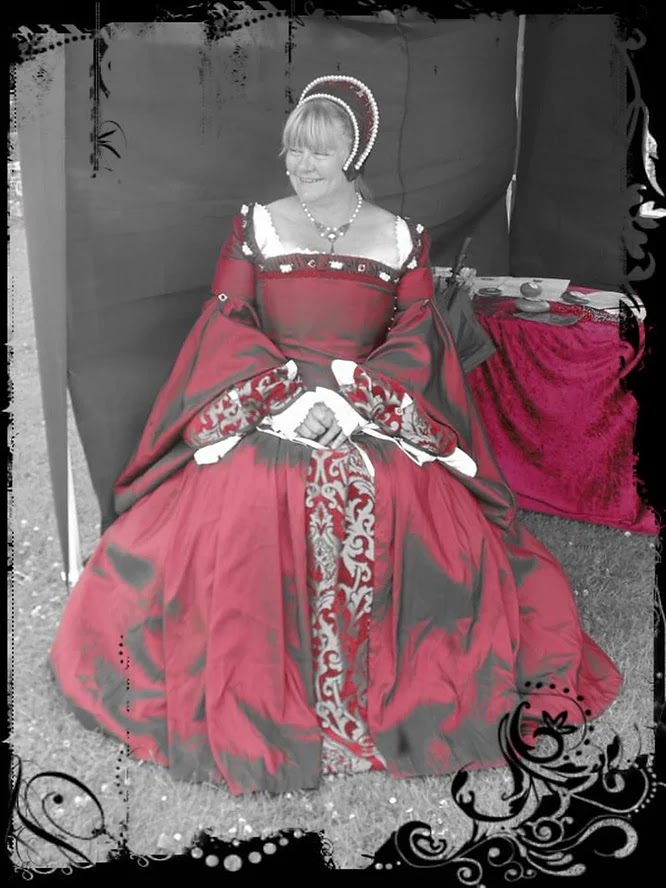
A lifelong history enthusiast and avid reader, Judith holds a BA in English/Creative writing and a Masters in Medieval Studies. She lives on the coast of West Wales where she writes both fiction and non-fiction. She is best known for her novels set in the Medieval and Tudor period, focussing on the perspective of historical women but recently she has written a trilogy from the perspective of Henry VIII himself. Judith is also a founder member of a re-enactment group called The Fyne Companye of Cambria which is when and why she began to experiment with sewing historical garments. She now makes clothes and accessories both for the group and others. She is not a professionally trained sewer but through trial, error and determination has learned how to make authentic looking, if not strictly historically accurate clothing. A non-fiction book about Tudor clothing, How to Dress like a Tudor, was published in 2023 by Pen and Sword. She runs a small seaside holiday let in Aberporth and when she has time for fun, likes to garden and restore antique doll’s houses. You can find her on most social media platforms.
Connect with Judith:

No comments:
Post a Comment
See you on your next coffee break!
Take Care,
Mary Anne xxx