Thursday, 7 May 2020

Join #HistoricalFiction author, Sharon Bradshaw, as she takes a look at Storytelling... From The Dark Ages #DarkAges @sharonbradshaw0


Storytelling... From The Dark Ages
By Sharon Bradshaw

Riders of the Sidhe.

Once Upon A Time

Many of our Faery tales are based on a much darker past, than the revised versions which appeared in the 19th century would have us believe. Those from the pens of writers like the Brothers Grimm, and Hans Christian Andersen. Rapunzel and Cinderella, with their once upon a time and happy ever after endings, are rooted at least as far back as the pre-Christian Dark Ages or early Medieval period. From the date when the Romans left the British Isles circa 410AD, to the Norman Conquest of 1066AD. A good tale gains validity and power when it becomes part of folk memory, passed down across the centuries. To entertain, teach, and inspire later generations. As in the above painting, Riders of the Sidhe by John Duncan (1866 - 1945), which is a lovely evocation of the Fae.

Faeries can be found in the beliefs of the Dark Ages. When the Church was still trying to gain a stronger foothold in the British Isles. Paganism existed initially alongside its teachings, until there were sufficient conversions to the new religion for the old ways to be discouraged. Celebration of the seasons and natural wheel of the year, upon which life itself depended, and the otherworld where all would travel when they passed from here. The Faeries were there too, whilst the Tuatha De Danaan are still with us today in the retelling of their story. The Faery procession, or Old Gods and Goddesses, which ride out from the hollow hills of Ireland.

Vikings.

All Grist for the Storyteller's Mill

Ornately carved weapons, jewellery, and beautiful manuscripts were made by skilled hands in the early Medieval period. If you think of Tolkien's Lord of the Rings you won't wander far from the truth, of the magical world it was then. People believed in the existence of Dragons, Wyrms that lived beneath the earth, and Gods and Goddesses who were capable of fantastic feats. All grist for the mill of Storyteller, Bard, and Scop! Also Beowulf, which may well have had its origins in the 7th century halls, and before. When a good tale would have been appreciated, on a long winter night.

A different slant was given to the old tales, by the Romantic movement of artists in the 1800s. Pre-Raphaelites like Dante Gabriel Rossetti (1828 -1882), Edward Burne-Jones (1833 - 1898), and others. The Druids also experienced a significant revival at this time. The little we know about them from the Greeks who had travelled through Celtic lands in the late Iron Age. Books too, written by Romans, such as Julius Caesar and Tacitus. Giving us the white robed figures who wander hill and dale, as magicians or wizards, and had returned to cut the mistletoe at Yule with a sickle knife.

The Last Sleep of Arthur.

The Quest for Arthur

The above painting is The Last Sleep of Arthur, by Edward Burne-Jones. Arthur can also be traced back to the Dark Ages. A real man, or figment of a much earlier imagination? We may never know the truth, but there is a convincing argument that he was a Pictish Aetheling, and 6th century contemporary of Saint Columba. Whilst other historians believe that he may have had his roots in Wales, and the Mabinogion tales, or possibly a myriad of other places. It's left now for us to decide, and enjoy the version of his story we prefer. Just like many Faery stories they are written with a sprinkling of magic, and enchantment.

I was inspired as a child, to learn that Arthur would return if we were in dire need of help. Only to discover later that this part of the legend came from the quill of Chretien de Troyes. The 12th century French poet who was one of the first writers to give Lancelot a prominent part in Arthur's story, and whose sources remain unclear. Did this possibly come from a much earlier account which had survived? Many believe that legend contains a grain of truth. Perhaps it was Christ's resurrection instead that was woven into Chretien's poem? Or was it only a tale from the past?

A Druid's Magic.

My Storytelling and Books

When I wrote a novel about a Monk in 794AD, I realised that Durstan would have been much closer to Arthur's world than we are today. That the tales he listened to in the Lord's Hall on Mull would have been different, and one or two might well have been about Arthur. Especially if he was the 6th century Pictish Aetheling, Artuir Mac Aedan, as I like to believe. It is thought that he was buried on Iona where a large part of Durstan's story takes place. Therein lies the magic of storytelling, faery tales, and legend. They can connect us to our past, people, and places.

Since my last post for The Coffee Pot Book Club I have been researching the history behind many of our old tales. So that I could write, The Woodcutter And The Faery Queen. My new book, coming soon!

In the meantime The Monk Who Cast A Spell, the first novel in my Durstan series, is available now on Amazon. Also its prequel, A Druid's Magic, in which you can find out more about storytelling... from the Dark Ages.

The Monk Who Cast A Spell
By Sharon Bradshaw


Durstan, a young Monk, falls in love with Ailan in 794AD. She disappears after their sexual awakening at Beltane. He is shocked and confused when he meets her again, several months later. Beth believes that she can obtain the protection of the Christian Church by manipulating Durstan’s emotions, and he is drawn to her.
Their story unfolds against the beautiful scenery of Scotland’s Hebridean islands. People cross the sea in coracles from Iona to Mull. They walk through ancient forest to Lord Duncan’s Hall inside its timber enclosure. The seasons change from Spring to mid-Winter when the Old Gods are in the magic of the firelight, and the shadows at Yule.
The early Christian Church continues to be challenged by tradition, and the Druids. Charms, amulets, and spells are prevalent. Life at the monastery is harsh, and Durstan is involved in the Viking raids. He doubts his religious beliefs in a society which is dominated by fear of violence, being outcast, or enslaved. Men and women in the 8th century are seeking protection from the most powerful God; Lord, or Abbot.
And Durstan’s quest? To regain Ailan’s love.

Pick up your copy of
The Monk Who Cast A Spell

Sharon Bradshaw

Sharon Bradshaw is a Historical Fiction Author, Storyteller, and Poet. She loves reading archaeology books, and delving into the 8th century to write the Durstan series. The Monk Who Cast a Spell, available now on Amazon  is set in the real Middle Earth we called the Dark Ages.

Subscribers to The Storyteller’s Newsletter will receive free short stories from her, and updates on her Author news.

Sharon also enjoys speaking about her novels, and how all this came about. She lives with her family and a large collection of books, near Warwick Castle, in the UK.

Please visit her Website for more information, and follow her on Facebook and Twitter.


#BookReview — People Like Us by Louise Fein #HistoricalFiction #WWII @FeinLouise


People Like Us
By Louise Fein


Leipzig, 1930s Germany.
Hetty Heinrich is a perfect German child. Her father is an SS officer, her brother in the Luftwaffe, herself a member of the BDM. She believes resolutely in her country, and the man who runs it.
Until Walter changes everything. Blond-haired, blue-eyed, perfect in every way Walter. The boy who saved her life. A Jew.
Anti-semitism is growing by the day, and neighbours, friends and family members are turning on one another. As Hetty falls deeper in love with a man who is against all she has been taught, she begins to fight against her country, her family and herself. Hetty will have to risk everything to save Walter, even if it means sacrificing herself...


“These are difficult times. That’s why Vati does all this work for the SS as well as running the newspaper. They must protect Hitler and ban all the parties that seek to oppose him. Pick your friends carefully, Hetty. Stick only with good Germans, like us. Do you understand?”

Hetty Heinrich does understand. After all, Hitler lives inside her skull, telling her what she should and should not do. She would never disappoint him by mixing with bad Germans.

However, when her childhood hero, Walter, is made an example of in front of the whole school because he is a Jew, Hetty feels a moment of rebellion. He is her friend. He will always be her friend.

With Walter now firmly banished from their lives, Hetty becomes indoctrinated with Nazi ideology, but she still cannot forget that blonde-haired, blue-eyed boy from her childhood.

A chance meeting with Walter, several years later, leaves Hetty questioning everything she thought she knew. Now she faces the greatest battle of her life. To save a life, she must silence Hitler’s voice in her head once and for all...

From a near fateful drowning to a reunion that was decades in the making, People Like Us by Louise Fein is the heartbreakingly enthralling story of one young woman who dared to stand up to the Nazi regime to save the life of the man she loved.

People Like Us is an emotionally charged story that gripped me from the opening sentence and held my attention to the last full stop. With a rich and realistic historical backdrop, Fein has presented her readers with a tale that is not only unputdownable but one that is unforgettable. 

We first meet Hetty when she is an adorable seven-year-old child who has a severe case of hero-worship towards her brother’s best friend. We watch as she grows up into a young teen who idolises Hitler, and like many others during this time, Hetty subconsciously seeks out potential enemies of the Reich. This, however, changes when she is reunited with Walter. Despite what she has been told about the filthy Jews, Hetty cannot bring herself to think that way about Walter. With Walter’s gentle yet honest explanations, Hetty’s eyes are opened and what she sees shakes the very foundations of her life and belief. Hetty is a very conflicted protagonist who, when she realises that she has been fed a dish of lies, does her utmost to help those whom the Nazis blame for everything. Her relationship with Walter is heartrendingly tender. Hetty is a character that really touched my heart. She is this brave and wonderful young woman who will do absolutely anything for the man she loves, including risking her own life and happiness. Her great sacrifice is lessened by the fact that if she had to do it all over again, she would, and by losing everything she finds a truer version of herself.

Walter is a wonderfully brave hero who faces so much adversity in this book, but he does not let that change his gentle and loving nature. I adored everything about Walter. He is kind, considerate, and he absolutely adores Hetty. His desperate desire to live a normal life, to spend time with his girl, is taken from him by a cruel, narcissistic regime which has to blame someone for all of Germany's failures, so why not the Jews? Walter suffers terribly in this novel — the things he witnesses, the things that he experiences, are truly dreadful, and it would have been very easy for him to see in Hetty all that was wrong with Germany, but he does not. He is a genuinely caring person who I could not help but admire.

People Like Us is a story that has been meticulously researched. The hours that Fein has spent researching this era shines clearly through the enthralling narrative and the lyrical prose. The depiction of Kristallnacht (Night of Broken Glass) in 1938 was particularly well-drawn. Fein also demonstrates how quickly the ideology of Hitler and his Nazi Party spread through Germany like a sadistic sort of Blitzkrieg. The idea that Hitler explored in Mein Kampf about the ‘Big Lie’ that the Jews so-called told is ironic when one considers the lies he used to turn a nation against its Jewish inhabitants. The relationship between Walter and Karl, Hetty’s brother, shows how easily dismissed life-long friends were, and despite Walter having once saved Hetty’s life, he is now seen by Hetty’s parents as an inferior being who is suddenly the enemy of the state for no other reason than his ancestry. Informing on parents, neighbours, friends became a new normal, and one that Hetty strongly believes in until she discovers the truth of what is happening in these so-called political prison camps, but even then, Hitler’s voice still makes her doubt the truth. There is one very emotional scene when Hetty can no longer bear to look upon the portrait of Hitler she has hanging in her bedroom and so she takes it down and hides it. This small act of defiance is the beginning of a dangerous and uncertain future for Hetty and one that she can never turn back from.

This book is an emotional journey, so have some tissues at hand while you read it. Fein certainly has a novelist intuition into the human condition — its fragility and its strength. But on top of this, Fein also has a keen eye on what makes a book entertaining — what makes a reader want to turn those pages and keep reading. This is the kind of book a reader can lose themselves in and it is near on impossible to put down. 

If you are a lover of quality World War II Historical Fiction then People Like Us by Louise Fein is a book that not only deserves a place on your bookshelf, but it is also one that demands to be read over and over again.

I Highly Recommend.

Review by Mary Anne Yarde
The Coffee Pot Book Club.


Pick up your copy of
People Like Us

 "Daughter of the Reich"
Will be released on May 12th in the USA
Pre-Order your copy today
Amazon US


Louise Fein

Louise Fein was born and brought up in London. She harboured a secret love of writing from a young age, preferring to live in her imagination than the real world. After a law degree, Louise worked in Hong Kong and Australia, travelling for a while through Asia and North America before settling back to a working life in London. She finally gave in to the urge to write, taking an MA in creative writing, and embarking on her first novel, Daughter of the Reich (named People Like Us in the UK and Commonwealth edition). The novel was inspired by the experience of her father's family, who escaped from the Nazis and arrived in England as refugees in the 1930's. Louise lives in the beautiful English countryside with her husband, three children, small dog and the local wildlife who like to make an occasional appearance in the house

Connect with Louise: Website • Blog • Twitter • Goodreads.


Wednesday, 6 May 2020

Let’s have a sneak peek between the covers of The Road to Liberation: Trials and Triumphs of WWII (A Collection) #HistoricalFiction #WW2 #BlogTour @JJToner_ya @MarionKummerow @marosikok


Stolen Childhood
By Marion Kummerow’s


Let’s have a sneak peek between the covers of The Road to Liberation. Below is an excerpt of Marion Kummerow’s fabulous book — Stolen Childhood


Excerpt


“Watch me and learn,” Laszlo whispered to Mindel, as they were hiding outside the back door of the kitchen barracks. 

“What are you going to do?” Mindel whispered back, goosebumps rising on her skin. She was scared someone might see them and Laszlo looked as if he were up to no good, but she wasn’t going to let him see her fear. The other children in the group had argued she was too little to hang out with them, but he’d stuck up for her.

She looked up at him with raw adulation. He seemed so grown-up and was so courageous, he was her champion and she’d do whatever he wanted. For the past days she’d followed him around, always eager to please him and make him proud of her. She’d prove the other children wrong and show them she wasn’t too little.

Laszlo peeked around the corner of the building and then pulled her over until she could see as well. “That bucket is my goal.”

Mindel looked at the woman in the kitchen who was pulling potatoes from a large gunny sack and peeling them into a bucket – the same bucket Laszlo had pointed to. 

“Those are potato peels,” she whispered back. 

“And they taste really good. I’m going to get us some.”

“But that’s stealing,” Mindel said, appalled at his heinous plan.

“So what?” 

She stared at him, her mind wandering back to her parents’ farm. One time, her mother had made a birthday cake for Israel, but everyone had only been allowed a small slice before she’d covered it and put it away for the next day. Mindel and Aron had waited until her mother walked out to milk the cows, snuck into the kitchen pantry and each grabbed a huge slice into their hands.

Out of fear of being caught red-handed, they’d crouched in the pantry and stuffed the cake into their mouths as fast as they could. Once the deed was accomplished, they snuck out and into the garden, pretending nothing had happened. 

But the moment her mother saw them, her lovely face turned red and she called them out on stealing the cake. Even today, Mindel had no idea how her mother had found out, since they’d been so careful. 

It had been a horrible moment when her mother had taken Mindel’s sticky hands, turned them with the palm upward and hit her with a wooden spoon. Aron hadn’t fared much better either, and both had been sent to their bedroom without dinner that day. 

Mindel had never again stolen even a morsel of food from the pantry. 

“Please, don’t. You’ll get in trouble. They’ll beat you,” she pleaded with Laszlo.

“Only if I get caught. And I’d rather take a beating than starve to death.”

Mindel heard his words and the truth behind them, but she wasn’t sure she agreed. In the camp people got beaten all the time for tiny misdeeds and it wasn’t with a wooden spoon, but with truncheons and whips. She’d even seen people fall down and never get up again after a beating. She didn’t want that to happen to Laszlo. He was her friend. 

“See that little cubbyhole by the shelves?” Laszlo asked.

She craned her head until she saw it, and nodded. 

“You’re fast and small, so you sneak inside and hide there. I’ll stand guard out here. Once the woman turns her back to you, grab as much from the bucket as you can and run back here to me. I’ll create a distraction if I need to.”

All the blood drained from her head and she suddenly felt dizzy. “You want me to steal the potato skins?”

“It’s called organizing food, not stealing. If you pass this test, I’ll make you a member of our gang.”

Mindel swallowed. She so badly wanted to be part of the gang. To belong to someone. And she was hungry. Very hungry. But stealing was wrong. Her mother would be so disappointed. 

Laszlo saw her wavering and insisted, “I dare you. You can’t be with us if you’re a chickenshit.”

She hated this word. Aron had always name-called her this and worse when she hadn’t obeyed his stupid rules. She squared her shoulders and said, “I’ll do it, because I’m brave.” 

Quivering with fear, she bit her lip, thinking of a way to get out of this dare. She repeated Laszlo’s words, telling herself it wasn’t really stealing – because the SS men were so mean and didn’t give them enough. But not even that helped to calm her nerves. 

Laszlo nudged her forward. “Ready? Then go.” 

Mindel nodded. Gathering up all her courage she crept forward, intent on pretending this was simply a game of hide and seek. Back on the farm she’d been a master, hiding in the smallest crevices without making a sound. Most of the time, her brothers would walk right by her, never knowing that she was merely inches away from them.


The Road to Liberation: Trials and Triumphs of WWII
A Collection
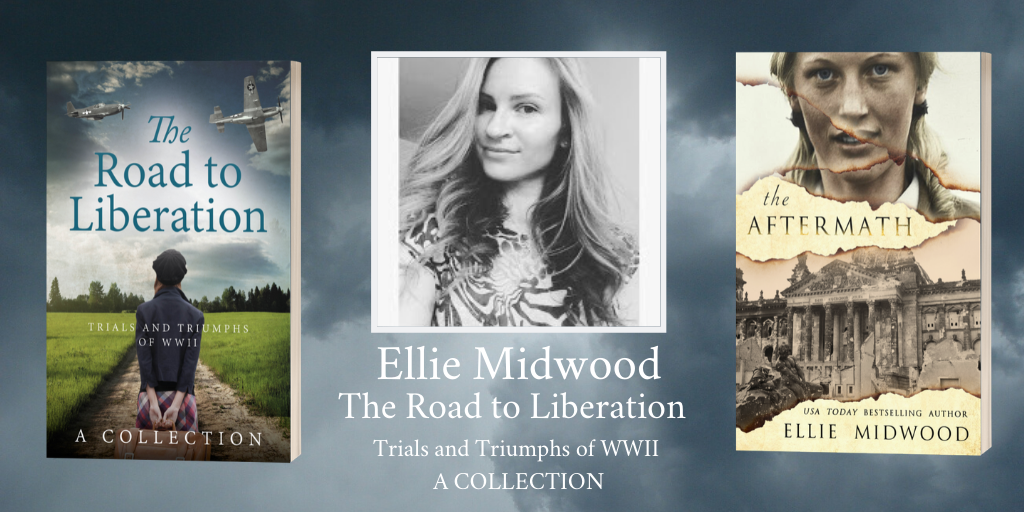
By Marion Kummerow, Marina Osipova, Rachel Wesson, JJ Toner, Ellie Midwood, and Chrystyna Lucyk-Berger.


Riveting stories dedicated to celebrating the end of WWII.
From USA Today, international bestselling and award-winning authors comes a collection filled with courage, betrayal, hardships and, ultimately, victory over some of the most oppressive rulers the world has ever encountered.
By 1944, the Axis powers are fiercely holding on to their quickly shrinking territories.
The stakes are high—on both sides:
Liberators and oppressors face off in the final battles between good and evil. Only personal bravery and self-sacrifice will tip the scales when the world needs it most.
Read about a small child finding unexpected friends amidst the cruelty of the concentration camps, an Auschwitz survivor working to capture a senior member of the SS, the revolt of a domestic servant hunted by the enemy, a young Jewish girl in a desperate plan to escape the Gestapo, the chaos that confused underground resistance fighters in the Soviet Union, and the difficult lives of a British family made up of displaced children..
2020 marks 75 years since the world celebrated the end of WWII. These books will transport you across countries and continents during the final days, revealing the high price of freedom—and why it is still so necessary to “never forget”.

Stolen Childhood by Marion Kummerow
The Aftermath by Ellie Midwood
When's Mummy coming? by Rachel Wesson
Too Many Wolves in the Local Woods by Marina Osipova
Liberation Berlin by JJ Toner
Magda’s Mark by Chrystyna Lucyk-Berger

Pick up your copy of
The Road to Liberation
Amazon US • Amazon UK • Amazon CA


Marion Kummerow


Marion Kummerow was born and raised in Germany, before she set out to "discover the world" and lived in various countries. In 1999 she returned to Germany and settled down in Munich where she's now living with her family.


After dipping her toes with non-fiction books, she finally tackled the project dear to her heart. UNRELENTING is the story about her grandparents, who belonged to the German resistance and fought against the Nazi regime. It's a book about resilience, love and the courage to stand up and do the right thing.
Marina Osipova


Marina Osipova was born in East Germany into a military family and grew up in Russia where she graduated from the Moscow State Institute of History and Archives. She also has a diploma as a German language translator from the Moscow State Institute of Foreign Languages. In Russia, she worked first in a scientific-technical institute as a translator then in a Government Ministry in the office of international relations, later for some Austrian firms. For seventeen years, she lived in the United States where she worked in a law firm. Eventually, she found her home in Austria. She is an award-winning author and a member of the Historical Novel Society.
Rachel Wesson


Rachel Wesson is Irish born and bred. Drawn to reading from an early age, she started writing for publication a few years back. When she is not writing, Rachel likes to spend her time reading and playing with her three kids. Living in Dublin there are plenty of things to do, although the cowboys and Indians of her books rarely make an appearance. To chat with Rachel connect with her on Facebook - authorrachelwesson. To check out her newest releases sign up to her mailing list.


My background is in Mathematics and computing, but I have been writing full time since 2005. I write short stories and novels. My novels include the bestselling WW2 spy story 'The Black Orchestra', and its three sequels, 'The Wings of the Eagle', 'A Postcard from Hamburg', and 'The Gingerbread Spy'.
Many of my short stories have been published in mainstream magazines. Check out 'EGGS and Other Stories' - a collection of satirical SF stories. I was born in a cabbage patch in Ireland, and I still live here with my first wife, although a significant part of our extended family lives in Australia.

Ellie Midwood


Ellie Midwood is a USA Today bestselling and award-winning historical fiction author. She owes her interest in the history of the Second World War to her grandfather, Junior Sergeant in the 2nd Guards Tank Army of the First Belorussian Front, who began telling her about his experiences on the frontline when she was a young girl. Growing up, her interest in history only deepened and transformed from reading about the war to writing about it. After obtaining her BA in Linguistics, Ellie decided to make writing her full-time career and began working on her first full-length historical novel, "The Girl from Berlin." Ellie is continuously enriching her library with new research material and feeds her passion for WWII and Holocaust history by collecting rare memorabilia and documents.

In her free time, Ellie is a health-obsessed yoga enthusiast, neat freak, adventurer, Nazi Germany history expert, polyglot, philosopher, a proud Jew, and a doggie mama. Ellie lives in New York with her fiancé and their Chihuahua named Shark Bait.

Chrystyna Lucyk-Berger


Chrystyna Lucyk-Berger was born in Minnesota in 1969 and grew up in the culture-rich neighborhood of "Nordeast" Minneapolis. She started her writing career with short stories, travel narratives, worked as a journalist and then as a managing editor for a magazine publisher before jumping the editor's desk and pursuing her dreams of writing and traveling. In 2000, she moved to western Austria and established her own communications training company. In 2005, she self-published a historical narrative based on her relatives' personal histories and experiences in Ukraine during WWII. She has won several awards for her short stories and now primarily writes historical fiction. During a trip into northern Italy over the Reschen Pass, she stood on the edge of Reschen Lake and desperately wanted to understand how a 15th-century church tower ends up sticking out of the water. What stories were lying beneath? Some eight years later, she launched the "Reschen Valley" series with five books and a novella releasing between 2018 and 2021.
For more on Chrystyna, dive in at inktreks(dot)com.