

Stolen Childhood
By Marion Kummerow’s


Let’s have a sneak peek between the covers of The Road to Liberation. Below is an excerpt of Marion Kummerow’s fabulous book — Stolen Childhood
Excerpt
“Watch me and learn,” Laszlo whispered to Mindel, as they were hiding outside the back door of the kitchen barracks.
“What are you going to do?” Mindel whispered back, goosebumps rising on her skin. She was scared someone might see them and Laszlo looked as if he were up to no good, but she wasn’t going to let him see her fear. The other children in the group had argued she was too little to hang out with them, but he’d stuck up for her.
She looked up at him with raw adulation. He seemed so grown-up and was so courageous, he was her champion and she’d do whatever he wanted. For the past days she’d followed him around, always eager to please him and make him proud of her. She’d prove the other children wrong and show them she wasn’t too little.
Laszlo peeked around the corner of the building and then pulled her over until she could see as well. “That bucket is my goal.”
Mindel looked at the woman in the kitchen who was pulling potatoes from a large gunny sack and peeling them into a bucket – the same bucket Laszlo had pointed to.
“Those are potato peels,” she whispered back.
“And they taste really good. I’m going to get us some.”
“But that’s stealing,” Mindel said, appalled at his heinous plan.
“So what?”
She stared at him, her mind wandering back to her parents’ farm. One time, her mother had made a birthday cake for Israel, but everyone had only been allowed a small slice before she’d covered it and put it away for the next day. Mindel and Aron had waited until her mother walked out to milk the cows, snuck into the kitchen pantry and each grabbed a huge slice into their hands.
Out of fear of being caught red-handed, they’d crouched in the pantry and stuffed the cake into their mouths as fast as they could. Once the deed was accomplished, they snuck out and into the garden, pretending nothing had happened.
But the moment her mother saw them, her lovely face turned red and she called them out on stealing the cake. Even today, Mindel had no idea how her mother had found out, since they’d been so careful.
It had been a horrible moment when her mother had taken Mindel’s sticky hands, turned them with the palm upward and hit her with a wooden spoon. Aron hadn’t fared much better either, and both had been sent to their bedroom without dinner that day.
Mindel had never again stolen even a morsel of food from the pantry.
“Please, don’t. You’ll get in trouble. They’ll beat you,” she pleaded with Laszlo.
“Only if I get caught. And I’d rather take a beating than starve to death.”
Mindel heard his words and the truth behind them, but she wasn’t sure she agreed. In the camp people got beaten all the time for tiny misdeeds and it wasn’t with a wooden spoon, but with truncheons and whips. She’d even seen people fall down and never get up again after a beating. She didn’t want that to happen to Laszlo. He was her friend.
“See that little cubbyhole by the shelves?” Laszlo asked.
She craned her head until she saw it, and nodded.
“You’re fast and small, so you sneak inside and hide there. I’ll stand guard out here. Once the woman turns her back to you, grab as much from the bucket as you can and run back here to me. I’ll create a distraction if I need to.”
All the blood drained from her head and she suddenly felt dizzy. “You want me to steal the potato skins?”
“It’s called organizing food, not stealing. If you pass this test, I’ll make you a member of our gang.”
Mindel swallowed. She so badly wanted to be part of the gang. To belong to someone. And she was hungry. Very hungry. But stealing was wrong. Her mother would be so disappointed.
Laszlo saw her wavering and insisted, “I dare you. You can’t be with us if you’re a chickenshit.”
She hated this word. Aron had always name-called her this and worse when she hadn’t obeyed his stupid rules. She squared her shoulders and said, “I’ll do it, because I’m brave.”
Quivering with fear, she bit her lip, thinking of a way to get out of this dare. She repeated Laszlo’s words, telling herself it wasn’t really stealing – because the SS men were so mean and didn’t give them enough. But not even that helped to calm her nerves.
Laszlo nudged her forward. “Ready? Then go.”
Mindel nodded. Gathering up all her courage she crept forward, intent on pretending this was simply a game of hide and seek. Back on the farm she’d been a master, hiding in the smallest crevices without making a sound. Most of the time, her brothers would walk right by her, never knowing that she was merely inches away from them.
The Road to Liberation: Trials and Triumphs of WWII
A Collection
By Marion Kummerow, Marina Osipova, Rachel Wesson, JJ Toner, Ellie Midwood, and Chrystyna Lucyk-Berger.

Riveting stories dedicated to celebrating the end of WWII.
From USA Today, international bestselling and award-winning authors comes a collection filled with courage, betrayal, hardships and, ultimately, victory over some of the most oppressive rulers the world has ever encountered.
By 1944, the Axis powers are fiercely holding on to their quickly shrinking territories.
The stakes are high—on both sides:
Liberators and oppressors face off in the final battles between good and evil. Only personal bravery and self-sacrifice will tip the scales when the world needs it most.
Read about a small child finding unexpected friends amidst the cruelty of the concentration camps, an Auschwitz survivor working to capture a senior member of the SS, the revolt of a domestic servant hunted by the enemy, a young Jewish girl in a desperate plan to escape the Gestapo, the chaos that confused underground resistance fighters in the Soviet Union, and the difficult lives of a British family made up of displaced children..
2020 marks 75 years since the world celebrated the end of WWII. These books will transport you across countries and continents during the final days, revealing the high price of freedom—and why it is still so necessary to “never forget”.
Stolen Childhood by Marion Kummerow
The Aftermath by Ellie Midwood
When's Mummy coming? by Rachel Wesson
Too Many Wolves in the Local Woods by Marina Osipova
Liberation Berlin by JJ Toner
Magda’s Mark by Chrystyna Lucyk-Berger
Pick up your copy of
The Road to Liberation
Amazon US • Amazon UK • Amazon CA

Marion Kummerow
Marion Kummerow was born and raised in Germany, before she set out to "discover the world" and lived in various countries. In 1999 she returned to Germany and settled down in Munich where she's now living with her family.
After dipping her toes with non-fiction books, she finally tackled the project dear to her heart. UNRELENTING is the story about her grandparents, who belonged to the German resistance and fought against the Nazi regime. It's a book about resilience, love and the courage to stand up and do the right thing.
Marina Osipova

Marina Osipova was born in East Germany into a military family and grew up in Russia where she graduated from the Moscow State Institute of History and Archives. She also has a diploma as a German language translator from the Moscow State Institute of Foreign Languages. In Russia, she worked first in a scientific-technical institute as a translator then in a Government Ministry in the office of international relations, later for some Austrian firms. For seventeen years, she lived in the United States where she worked in a law firm. Eventually, she found her home in Austria. She is an award-winning author and a member of the Historical Novel Society.
Rachel Wesson

Rachel Wesson is Irish born and bred. Drawn to reading from an early age, she started writing for publication a few years back. When she is not writing, Rachel likes to spend her time reading and playing with her three kids. Living in Dublin there are plenty of things to do, although the cowboys and Indians of her books rarely make an appearance. To chat with Rachel connect with her on Facebook - authorrachelwesson. To check out her newest releases sign up to her mailing list.

My background is in Mathematics and computing, but I have been writing full time since 2005. I write short stories and novels. My novels include the bestselling WW2 spy story 'The Black Orchestra', and its three sequels, 'The Wings of the Eagle', 'A Postcard from Hamburg', and 'The Gingerbread Spy'.
Many of my short stories have been published in mainstream magazines. Check out 'EGGS and Other Stories' - a collection of satirical SF stories. I was born in a cabbage patch in Ireland, and I still live here with my first wife, although a significant part of our extended family lives in Australia.
Ellie Midwood
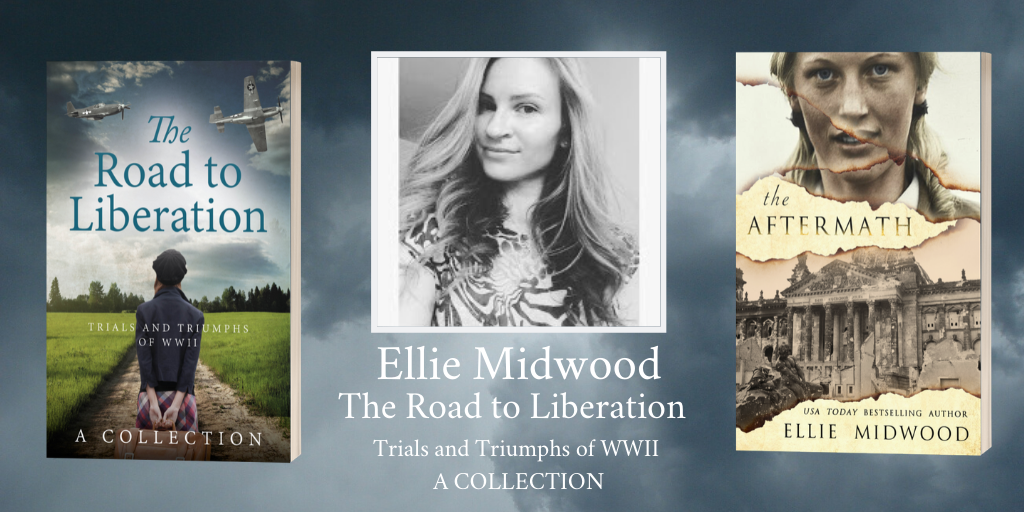
Ellie Midwood is a USA Today bestselling and award-winning historical fiction author. She owes her interest in the history of the Second World War to her grandfather, Junior Sergeant in the 2nd Guards Tank Army of the First Belorussian Front, who began telling her about his experiences on the frontline when she was a young girl. Growing up, her interest in history only deepened and transformed from reading about the war to writing about it. After obtaining her BA in Linguistics, Ellie decided to make writing her full-time career and began working on her first full-length historical novel, "The Girl from Berlin." Ellie is continuously enriching her library with new research material and feeds her passion for WWII and Holocaust history by collecting rare memorabilia and documents.
In her free time, Ellie is a health-obsessed yoga enthusiast, neat freak, adventurer, Nazi Germany history expert, polyglot, philosopher, a proud Jew, and a doggie mama. Ellie lives in New York with her fiancé and their Chihuahua named Shark Bait.
Chrystyna Lucyk-Berger

Chrystyna Lucyk-Berger was born in Minnesota in 1969 and grew up in the culture-rich neighborhood of "Nordeast" Minneapolis. She started her writing career with short stories, travel narratives, worked as a journalist and then as a managing editor for a magazine publisher before jumping the editor's desk and pursuing her dreams of writing and traveling. In 2000, she moved to western Austria and established her own communications training company. In 2005, she self-published a historical narrative based on her relatives' personal histories and experiences in Ukraine during WWII. She has won several awards for her short stories and now primarily writes historical fiction. During a trip into northern Italy over the Reschen Pass, she stood on the edge of Reschen Lake and desperately wanted to understand how a 15th-century church tower ends up sticking out of the water. What stories were lying beneath? Some eight years later, she launched the "Reschen Valley" series with five books and a novella releasing between 2018 and 2021.
For more on Chrystyna, dive in at inktreks(dot)com.


