

Too Many Wolves in the Local Woods
By Marina Osipova

Let’s have a sneak peek between the covers of The Road to Liberation. Below is an excerpt of Marina Osipova’s fabulous book — Too Many Wolves in the Local Woods
Excerpt
“If you already know everything about me and my family, why are you asking me all these questions?”
“Protocol demands that I should. And yes, you are right, we know everything. Interrupt me if I’m wrong.” He looked at her, not unkindly, and continued as if talking to a friend, his voice almost approving. “You were the best pupil at your elementary school, and you are now among the top students at the university. You proved yourself faithful and active first as a Pioneer and then as a Komsomol member and one of the best activists of the University’s Agitprop Brigade.” His gaze stopped for a fleeting moment on the Komsomol badge, which sat next to another, the GTO High Achiever, on her blouse.
“Your performance in athletics is astonishing. Sixty-meter sprint in nine seconds. One hundred meters in thirteen seconds. Long jump four meters ninety-five centimeters. Grenade throwing twenty meters. Well, that’s not great, but you can improve it with more practice. You are well-trained in speed skating, cross-cycle crossing, skiing, swimming.”
He has a good memory, or he prepared himself well.
“You are the best shooter in your OSOAVIAKHIM group in Engels, both with the small-bore rifle and the handgun, and from both hands at that.” He glanced at his hands and shook his head. “Astounding. I don’t know how anyone can do it.” He moved his eyes back to her.
Was there genuine admiration in them? He seemed to enjoy enumerating her successes as though they were his own. “You have made twelve parachute jumps.”
“Fourteen. Your information is not up to date.”
“Your last two jumps were not qualified.” As if she hadn’t interrupted him, he continued matter-of-factly, “And besides, I can’t help but commend you for applying for a pilot program.”
Aware that the last five minutes or so he spoke in perfect German with a slight accent she could not place—not the Volga German though—she had switched to the language too.
“I have to compliment you.”
“What for?” She arched her eyebrows, signaling her humorous surprise.
“You are quite a good actor. I liked you as the Commissar in the Optimistic Tragedy. How long were you with the school drama group?”
Had she been on their radar for six years? She calculated in her mind. “Since the fourth grade. Till I graduated. But why ask? You must have it in my dossier.”
Ignoring her sarcasm, he went on. “I have to praise your command of German. Most of your compatriots speak with such terrible accents. Do you speak German in your family?”
“Yes, with my father.”
“Franz Fridrikhovich Kriegshammer.” He shook his head as if bemused. “By now, most of the Soviet Germans have adopted Russian names.”
“People call him Franz Fyedorovich.”
“And his friends and colleagues, while visiting him, do they speak German?”
“Some do.”
“And what do they confer about?”
“I don’t eavesdrop.” Her mind turned to the image of her father’s colleagues and friends who, after a cup of tea, would proceed into his study where they continued their discussions in subdued tones, of which she could hear little.
Godyastchev’s voice broke into her reverie, “Did somebody visit your father lately? A person you hadn’t met before?”
“I don’t pay attention to who visits my father. I’m too busy.” The image of an aging man in an expensive, perfectly cut suit who showed up two weeks ago emerged in her memory. After an energetic handshake with her, he had disappeared with her father into the study. “Please close the door. It’s a confidential talk.” His voice was authoritative, in intelligent Russian. Replaying the scene in her head—was she suspected of snooping?—she felt annoyed now as she was then.
“You seem to contemplate whether you have to tell me something?”
She locked eyes with Godyastchev. “Yes. To ask why I am here?”
“I’ll answer your question later. Now, tell me how often you go to church? You are a protestant. Right?”
“I’m an atheist.”
“And your father?”
“He doesn’t go to a church either.”
“Going to a prayer service and being religious are two different things, you know?”
“He is not religious. Allow me to ask you again why all this questioning?”
“Easy, easy, Comrade Kriegshammer. Here, I ask questions.” His voice didn’t betray any irritation. “Are you acquainted with Petrushev and Ginzberg?”
“Not in person. But I’ve heard they were—”
“Yes, arrested. They disseminated anti-Soviet propaganda. By any chance, have you noticed who of your fellow students were in contact with them?”
She knew what he was getting at. “No,” she said, at the same time recalling how, on several occasions, she had spotted Rita talking to Ginzberg.
“Well.” He pushed a piece of paper across the table. “Here, you sign that you won’t divulge any information about our conversation.” He waited till she read the document and wrote her signature, then on a slip of paper, which he tore from his notepad, he scribbled something. “This is my phone number in case you have any information to share.” He looked at her from behind his glasses. She guessed she recognized something like approval as though he was sure that was not their first and last conversation. “You may go, Comrade Kriegshammer.”
Ulya breathed a sigh of relief and hastened to the auditorium, urged by the school bell ringing.
“I had to fight off people to keep a reserved place in the cafeteria. Where have you been?” Rita whispered as she moved aside to let Ulya take her place beside her on the bench in the lecture hall.
“I wasn’t hungry and went out to have a gulp of fresh air.”
“Attention, comrade students!” The lecturer banged the pulpit with his baton. “Today we continue on the topic of the political economy of Socialism. As our leader Comrade Stalin said in his speech at . . .”
But the lecture wasn’t on Ulya’s mind. The talk with the NKVD senior lieutenant left an unpleasant residue. What, do they expect me to become a stoolie? In my own family? Or denounce my fellow students? And instantly an unsettling thought surfaced. What has Rita in common with Ginzberg?
Her friend nudged Ulya. “Hey, stop daydreaming.”
“I’ll look at your notes later.” With her photographic memory, she could allow herself to be distracted.
“Next time, you make the notes,” Rita scoffed.
While making her way to the ferry after the last lecture, Ulya felt a strange presence over her, like a cloud or a shadow. She could not help but look around while hastening to the pier yet saw only the usual citizens—the students like herself; young mothers with prams or with older children; men and women rushing on their business; teenagers, noisy and carefree.
On the boat, crossing to her town on the opposite shore of the Volga River, Ulya peered into the swamp-green waves being cut by the smart vessel for a while, before turning her gaze to the passengers. Her eyes scanned them to read their ever-somber faces. Today, those were mostly familiar people: the elderly woman with a wicker basket covered with an embroidered cotton cloth had new shoes, which seemed to trouble her since she tried to kick them off her heels; the fidgeting teenager with his ever unkempt hair seemed uncomfortable with his shaved head, now and again touching it with his hands as though wondering where his hair had gone; and the old, pockmarked man of about fifty. She would prefer not to have him staring at her with his deep set, shifty eyes, lewdly licking his lips till wet.
Who were all these people? What was on their minds? How did they feel about Lenin and Stalin? Did they idolize them? Why did some citizens disappear without a trace, while others seemed to justify the actions of the authorities? Even glorified it—at least as the newspaper articles and radio broadcasts claimed. Did she belong to the latter? The arrest of two Komsomol members from her course was the first instance that cast a cloud of doubt over her. No. No. No. She snapped at herself mentally. How could she ever question the rightness of the Soviet power? No doubt, they committed some punishable crime.
The Road to Liberation: Trials and Triumphs of WWII
A Collection
By Marion Kummerow, Marina Osipova, Rachel Wesson, JJ Toner, Ellie Midwood, and Chrystyna Lucyk-Berger.

Riveting stories dedicated to celebrating the end of WWII.
From USA Today, international bestselling and award-winning authors comes a collection filled with courage, betrayal, hardships and, ultimately, victory over some of the most oppressive rulers the world has ever encountered.
By 1944, the Axis powers are fiercely holding on to their quickly shrinking territories.
The stakes are high—on both sides:
Liberators and oppressors face off in the final battles between good and evil. Only personal bravery and self-sacrifice will tip the scales when the world needs it most.
Read about a small child finding unexpected friends amidst the cruelty of the concentration camps, an Auschwitz survivor working to capture a senior member of the SS, the revolt of a domestic servant hunted by the enemy, a young Jewish girl in a desperate plan to escape the Gestapo, the chaos that confused underground resistance fighters in the Soviet Union, and the difficult lives of a British family made up of displaced children..
2020 marks 75 years since the world celebrated the end of WWII. These books will transport you across countries and continents during the final days, revealing the high price of freedom—and why it is still so necessary to “never forget”.
Stolen Childhood by Marion Kummerow
The Aftermath by Ellie Midwood
When's Mummy coming? by Rachel Wesson
Too Many Wolves in the Local Woods by Marina Osipova
Liberation Berlin by JJ Toner
Magda’s Mark by Chrystyna Lucyk-Berger
Pick up your copy of
The Road to Liberation
Marina Osipova
Marina Osipova was born in East Germany into a military family and grew up in Russia where she graduated from the Moscow State Institute of History and Archives. She also has a diploma as a German language translator from the Moscow State Institute of Foreign Languages. In Russia, she worked first in a scientific-technical institute as a translator then in a Government Ministry in the office of international relations, later for some Austrian firms. For seventeen years, she lived in the United States where she worked in a law firm. Eventually, she found her home in Austria. She is an award-winning author and a member of the Historical Novel Society.
Marion Kummerow

Marion Kummerow was born and raised in Germany, before she set out to "discover the world" and lived in various countries. In 1999 she returned to Germany and settled down in Munich where she's now living with her family.
After dipping her toes with non-fiction books, she finally tackled the project dear to her heart. UNRELENTING is the story about her grandparents, who belonged to the German resistance and fought against the Nazi regime. It's a book about resilience, love and the courage to stand up and do the right thing.
Rachel Wesson

Rachel Wesson is Irish born and bred. Drawn to reading from an early age, she started writing for publication a few years back. When she is not writing, Rachel likes to spend her time reading and playing with her three kids. Living in Dublin there are plenty of things to do, although the cowboys and Indians of her books rarely make an appearance. To chat with Rachel connect with her on Facebook - authorrachelwesson. To check out her newest releases sign up to her mailing list.

My background is in Mathematics and computing, but I have been writing full time since 2005. I write short stories and novels. My novels include the bestselling WW2 spy story 'The Black Orchestra', and its three sequels, 'The Wings of the Eagle', 'A Postcard from Hamburg', and 'The Gingerbread Spy'.
Many of my short stories have been published in mainstream magazines. Check out 'EGGS and Other Stories' - a collection of satirical SF stories. I was born in a cabbage patch in Ireland, and I still live here with my first wife, although a significant part of our extended family lives in Australia.
Ellie Midwood
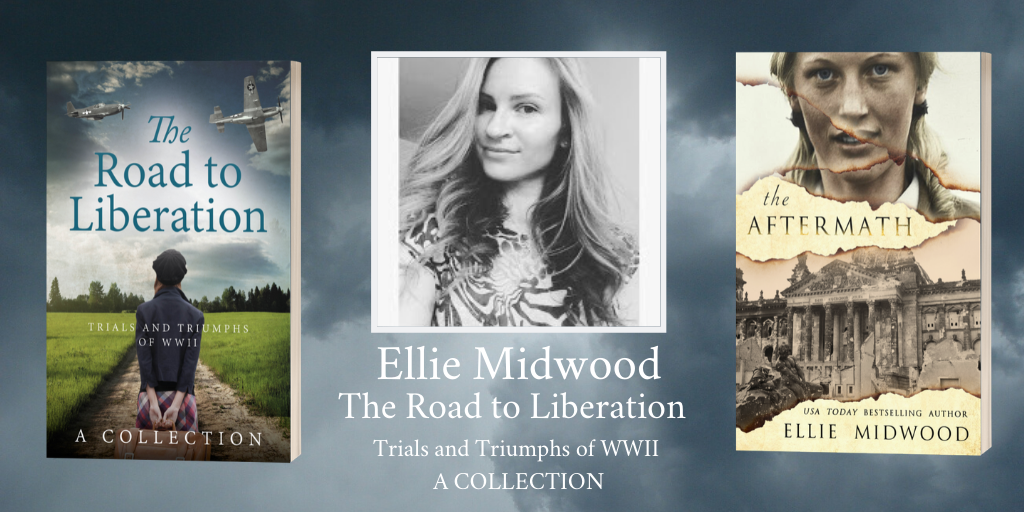
Ellie Midwood is a USA Today bestselling and award-winning historical fiction author. She owes her interest in the history of the Second World War to her grandfather, Junior Sergeant in the 2nd Guards Tank Army of the First Belorussian Front, who began telling her about his experiences on the frontline when she was a young girl. Growing up, her interest in history only deepened and transformed from reading about the war to writing about it. After obtaining her BA in Linguistics, Ellie decided to make writing her full-time career and began working on her first full-length historical novel, "The Girl from Berlin." Ellie is continuously enriching her library with new research material and feeds her passion for WWII and Holocaust history by collecting rare memorabilia and documents.
In her free time, Ellie is a health-obsessed yoga enthusiast, neat freak, adventurer, Nazi Germany history expert, polyglot, philosopher, a proud Jew, and a doggie mama. Ellie lives in New York with her fiancé and their Chihuahua named Shark Bait.
Chrystyna Lucyk-Berger

Chrystyna Lucyk-Berger was born in Minnesota in 1969 and grew up in the culture-rich neighborhood of "Nordeast" Minneapolis. She started her writing career with short stories, travel narratives, worked as a journalist and then as a managing editor for a magazine publisher before jumping the editor's desk and pursuing her dreams of writing and traveling. In 2000, she moved to western Austria and established her own communications training company. In 2005, she self-published a historical narrative based on her relatives' personal histories and experiences in Ukraine during WWII. She has won several awards for her short stories and now primarily writes historical fiction. During a trip into northern Italy over the Reschen Pass, she stood on the edge of Reschen Lake and desperately wanted to understand how a 15th-century church tower ends up sticking out of the water. What stories were lying beneath? Some eight years later, she launched the "Reschen Valley" series with five books and a novella releasing between 2018 and 2021.
For more on Chrystyna, dive in at inktreks(dot)com.


