Tuesday, 30 August 2016

Castle Dore and #Arthurian Legend #Cornwall


As you may know, I write historical fantasy set a generation after the fall of King Arthur. In The Du Lac Chronicles, my protagonist, Alden du Lac is the defeated King of Cerniw and his fort, called Castle Dore, has been razed to the ground. In The Pitchfork Rebellion, Alden sees first hand what the King of Wessex has done to his beloved fort. I want to have a look at the legend and the archaeological evidence of Castle Dore today.


Let's start with the legend.


Castle Dore was the home of King Mark of Cornwall and was the setting for one of the most beautifully tragic love story of all times. I am of course talking about Tristan and Iseult. Move over Romeo and Juliet you have nothing on these guys. If you want a recap on the legend, then check out the blog post I wrote on Sir Tristan. Now, on to the facts.


 Tristan and Iseult as depicted by Herbert Draper (1863–1920)

What do we know of Castle Dore?


Castle Dore is situated just outside of Fowey in Cornwall. It is an Iron Age Hill Fort ~ I know I know, not quite the Dark Age fort that we want, but hey, when you are talking about legends what's 1000 years between friends?!

There is some speculation that the name Castel Dore comes from the Cornish "Earth Castle," which has an appealing ring to it, doesn't it?

Excavations were carried out on the site in 1936 and 1937 by the famed, Dark Age, English archaeologist and historian Courtenay Arthur Ralegh Radford (1900-1999). He concluded that the fort was re-occupied in the 5th/6th Century, which would tie in nicely with the Arthurian legend. Just to note, Radford also excavated sites at Tintagel and Glastonbury Abbey as well. But later interpretation of the site suggests that it was an Iron Age fortification, with little of evidence of Dark Age occupation.

However...The fort was re-occupied in 1644 by the Earl of Essex and his Parliamentarian Army during the English Civil War. To cut a long story short, the Royalist surrounded Dore. Essex managed to escape although there was a great loss of life. It was a bitter blow to the Roundhead's and ultimately secured the South West for the king, until the final days of the war. 
 
 King Charles I

There is also evidence of a small village to the eastern gate of the Hillfort and in my books, Dore does have such a village.

I wonder why Dore was chosen to be part of the Arthurian story. It is small and seemingly insignificant and is now being left to crumble away. But whatever the reason, Dor is associated with the legend and I have to admit, there is something special about the place. 

And if you fancy checking out The Du Lac Chronicles, you can find the link below.

Monday, 29 August 2016

#bookreview ~ Smoke and Mirrors #YA #fantasy @Jess_Haines


Because sometimes a girl needs a dragon, not a knight.

Smoke and Mirrors
By
Jess Haines


A girl who uses her illusions to fool the world into thinking she's just like all the other magi.

A dragon who sees through her lies.

Together they just might survive a world that wants to control or destroy them both.


Kimberly may wield ultimate cosmic power, but even a mage has to pay the rent. No one will hire her for her magic talents until she's got the credentials, so she's stuck in a crappy rent controlled apartment with her mother, yearning for treats she can't afford at her part time job in a cafe, counting down the days until she graduates the secret Blackhollow Academy school for magi. Only then will she have the certificate she needs to land her dream job in a coven.

The problem? She needs a familiar to graduate.

As an illusionist, she doesn't have the ability to summon or create a familiar of her own. Her only option is to convince a supernatural creature to let her bind it instead. Since having a powerful Other at her beck and call would guarantee her a place in a coven after she graduates—and legendary treasure hoards are an added bonus—she thinks binding a dragon as her familiar will solve all her problems...

***
My thoughts on the book…

Smoke and Mirrors ~ was ever a book so aptly named?

A skilfully told story that captured my attention from the beginning and held it throughout. This is an action-packed adventure, with so many twists and turns that it left me with whiplash ~ but in a good way!!

The protagonist, Kimberly, is an incredibly well-crafted character. She is one paycheck away from eviction, but she hides her hardships behind an illusion. No one sees the tatty clothes or how thin she is from lack of food. All her classmates see is someone who doesn’t quite fit into the magical world. Kimberly is desperate to graduate. If she doesn’t, then she fears that there will be no way out of the poverty that currently defines her life. All she has to do is find a dragon that will consent to be her familiar. But, what dragon would want to bond with someone like her?

 I really liked Kimberly. She is a very loving and humble young lady, who doesn't come from a magical background ~ she only learnt that she had magic when she was 16 ~ because of this, Kimberly is sublimely unaware of the danger she is in. She seeks out Cormac, having no idea who he really is. She has been told that he can help her find a dragon. He is, therefore, her last hope.

Kimberly provokes strong protective emotions in Cormac, although at first, he is wary of her motives. Cormac cannot deny the physic desire he feels towards her and he cannot understand why he has this all-consuming, irrational want, to become her familiar.

I loved the characterisation of Cormac. He comes across as being incredibly wise and strong. You would want him in your corner! But there is also this endearing hint of vulnerability about him, which made him appealing. I enjoyed reading about him.

The antagonist, Viper, is a dark and poisonous character. He is suitably evil, although I am guessing there is a backstory to him, which I would be interested in learning about.

Smokes and Mirrors is a well-crafted and incredibly compelling novel. I loved the many mythical creatures. Haines has created a believable world with an endearing protagonist. A book worth reading.

I Highly Recommend.

 
Links to purchase

About the author
I'm a displaced New Yorker with a penchant for the silly, the obscure, and the fantastical. Tampa, Florida is home for the time being. I'm currently working on the H&W Investigations urban fantasy series and the Blackhollow Academy young adult contemporary fantasy series. Find out more about my books, drop me a line, or join my mailing list at www.jesshaines.com!
 

Thursday, 25 August 2016

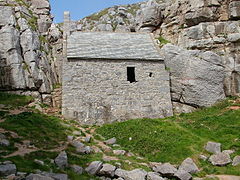
St Govan's Chapel ~ the final resting place of Sir Gawain? #Wales


Let me tell you a story...


There was once an Irish monk named Govan, who was travelling to Wales to visit family. The journey was uneventful until he reached Pembrokeshire. Here he was set upon by pirates. All hope was lost, until the cliff opened up and left a fissure just big enough for him to crawl into. Legend states that the cliff then folded itself around him, keeping Govan hidden from his pursuers. How fabulous is that?


But hold your horses, there is more...

So grateful was Govan for such divine intervention, that he decided that this was the perfect place for a hermitage.

Now, Govan built his little chapel and he had a beautiful little bell.  All was right with the world. Alas, those pirates came one night and stole the bell. Disaster.

But fear not, for the divine would intervene again. Some Angel's came down from Heaven and stole the bell back…

I don't know why that bit of the legend appeals to me so much, but it does.
Turn in next week for another exciting episode of,

Angels v. Pirates.

Who will win?!...

Obviously, the Angels won and they gave the bell back to Govan.

But what was to the stop the pirates coming back and stealing the bell again?

The Angels came up with a cunning plan. If they were to encase the bell into a huge stone, then no one, not even those pirates, would be able to steal it again. Clever!

Now, I know what you are thinking. How can you peal a bell when it is encased in stone? For Govan, this was surprisingly easy, and boy did he make that bell ring. I don't know how just take my word for it.


But that is not all. There is more. The legend states that you can still see Govan's handprints on the floor of the cave, and it is reputed that he is buried under the chapels alter. And for many years if you wanted your wishes to come true then this is where you should go to ask them.

But...we aren't interested in that version of history. Hell, no. We want to hear the Arthurian one.

Okey-dokey. Right. Now stretch your imagination a little. Govan ~ sounds a bit like Gawain, or vice-versa. Is Govan actually a corruption of Gawain? Who knows!

Gawain will fit. He will be associated with this chapel. One way or the other. So here goes...


We all know the story of how Lancelot killed Gawain's brothers in his bid to rescue Guinevere from the pyre and how Gawain travelled to Brittany to seek his revenge. Lancelot didn't want to fight him, but Gawain wouldn't back down. Lancelot accidently kills him in a duel etc…etc...

Ah, but wait. In this story, Gawain doesn't die by Lancelot's hands. Oh no. When Arthur dies, Gawain, like many other knights, decides to live a life of simplicity and peace. He travels all the way to Pembrokeshire in Wales and he becomes a hermit. He builds a chapel, and this is where he spends the rest of his days. Gawain is even buried under the chapel's alter.

See, we can make him fit.

I have to be honest; I love both versions of the legend. It is just perfect. Much like that little chapel.

Wednesday, 24 August 2016

Author’s Inspiration ~ Michael Reuel #history & #folklore @MichaelReuel


I am so excited to have Michael Reuel on the blog. His new book is definitely one I look forward to reading as it is all about Robin Hood!

Robin Hood Existed
By
Michael Reuel


Historians tend to point out that there is no historical evidence for the existence of Robin Hood, but there is an incredible amount of folkloric evidence for his existence that has gone overlooked.

Folklorist Michael Reuel delves into the legend in order to assess how much we can learn by studying folklore, without applying the rigid terms of ‘historical’ proof. In the process he discovers that, although folklore does have obvious limitations in terms of what it can prove, the sheer amount of source material on Robin Hood is nevertheless sufficient enough to conclude that the famous outlaw and his Merry Men did in fact exist.

If you are interested to understand how Reuel has been able to arrive at this conclusion, then his research is chronicled here in the ground-breaking ‘Robin Hood Existed’; a study that promises to open a new window upon the story of Robin Hood and the life of thirteenth to fourteenth-century England. 

As well as shedding new light upon the story of everyone’s favorite outlaw, Reuel provides a compelling exploration of the nature of storytelling, defining some of the key differences between how truth and myth manifest in the human psyche, and highlighting many factors that lead to certain peoples and stories becoming overlooked or dismissed by historians.

***


A few years back the opening line of Wikipedia’s ‘Robin Hood’ page kicked off with a sentence that was something like, ‘Robin Hood was a medieval outlaw who didn’t exist’.

I don’t have the exact wording as the page has since been improved on, but I remember the line well because it was the catalyst for leading me to begin the research for what I then didn’t know would end up turning into the upcoming publication ‘Robin Hood Existed’. From the title, I’m sure it’s pretty easy to guess that my conclusions disagree with whomever was responsible for that Wikipedia entry. An amended page was not enough for my liking, however. My instincts had always been to suppose there was a real person behind the legend, but I had turned a corner and wanted something of substance to explain why.

For someone in love with British folklore I was conscious of the fact that the journey might be perilous, leading only to disappointment. What if I ended up siding with the naysayers? But that was not the case. The more I looked at all the factors involved the more complete my picture of the legend became, so much so that I don’t even like using the word ‘legend’ anymore and have tried to purge it from the book as much as possible.

Before stumbling upon Wikipedia that day I had always interpreted the public mood towards the Robin Hood story as being one on which the jury is still out. Although I sided firmly with the camp that thought he did exist, even before my own research, I was comfortable with the status quo; there is no firm ‘historical’ evidence after all. Fearing that there might be a growing tendency to dismiss England’s – and perhaps the world’s – favourite hero in such a way, however, made me sensitive on the subject of credibility. I began to notice how those who don’t believe that certain folklore has some truth behind it are far readier to adopt a tone of being in the right than those who remain curious. But baseless scepticism has never equalled wisdom, any more than romanticism has. Plus, as anyone who enjoys reading up on their favourite period of history will attest, the picture of history that the public consciousness is presented with – even to the extent of being taught it in school – is very rarely one from which sound judgements can be made.

Before I started reading up on Robin Hood’s time, the period of history I was most familiar with, from personal interest, was that surrounding the Norman Conquest of England. Now anyone who knows anything about British history knows that 1066 is a pretty important date to consider. People who grew up in the UK do not have to be very historically aware to know who the winners and losers were at the Battle of Hastings. Even those who try to avoid history as an interest are likely to be able to say something about King Harold being the one who possibly died with an arrow embedded in his eye.

On the famous demise of England’s last Anglo-Saxon king, however, I feel it apt to point out that I have yet to come across any major historical publication, in the last 20 years at least, that has found reason to humour the conclusion that Harold II died with an arrow in the eye or chopped down by a horse rider, as the Bayeaux Tapestry suggests.

Yet, presumably for no other reason than because this is a debate that has rumbled on through history and so has become a force of habit, we are still taught that this is what happened. Certainly I was taught so at school and, as I have worked as a proofreader of educational material, I have also come across the same teachings in current school texts. Along with many other statements that are simply amazing, such as ‘England as a nation was formed in 1066’.

It was not and neither did those responsible for the Bayeaux Tapestry know how Harold II died. Everyone who has written on the events of 1066 knows this, as does everyone who has read up on the up-to-date conclusions available, but everyone else still gets the other version.

Similarly, ‘everyone else’ is still presented with a construct of the Robin Hood stories that has the outlaw motivated by keeping the throne of England from Prince John, during the time when Richard the Lionheart was at war in the Crusades. Whereas those who have researched the original stories know that the king on the throne during Robin Hood’s time was always an Edward.

They should also know that the outlaw was a ‘yeoman’, which in aristocratic terms basically means a nobody. And yet many who do humour the possibility that the folklore is genuine still attempt to layer its origins with the idea that ‘Robin Hood’ became a second identity for some nobleman or earl with a grudge. The Earl of Huntingdon becomes a regular suspect, as does a disinherited Robin of Loxley.

Understanding why historians have constantly attempted to tie the outlaw to an identity that can be traced within available records became an important part of my research. A folklorist needs to understand what smokescreens have been put up and why, before being able to assess what the purist interpretation of the story really is and the truth that is too often overlooked when studying Robin Hood is that the life and achievements of yeoman from the thirteenth or fourteenth centuries are not very likely to be historically proven at all.

So why are we so unable to appreciate the down-to-earth side of this famous hero? Can it be that our modern sentiments still remain more attached to the glory of royal blood and nobility than we would like to think? For sure these desperate attempts to give a man who lived in the woods some kind of link to the aristocracy suggest so.

A scene from the film Monty Python and the Holy Grail springs to mind. King Arthur, on his way to a castle occupied by ‘French types’, stops to speak to couple of peasant folk who are rolling around in the muck. Prior to this he has been identified as a king by the commoners because ‘he hasn’t got shit all over him’. The peasant folk he stops to speak to are not so interested in him as Mary Anne Yarde, as one of them says ‘Dennis, there’s some lovely filth down here’, which they then start gathering. With this image in mind, I can’t help feel that all the historical studies available have done very little to advance our view of what common medieval folk were like. The peasants are more than they seem though, questioning the king’s right to rule supremely over them because some ‘watery tart threw a sword at you’ and lecturing him about how they are an ‘anarcho-syndicalist commune’.

It would be nice to think that an exchange like this did actually happen, but I feel it is also apt to question whether we really went through the entire medieval period without there being a single peasant or yeoman who turned out to be a lot more than meets the eye.

My research for ‘Robin Hood Existed’ is not solely a historical one, therefore, but also a folkloric one. The search demanded that I discard looking for proof of the outlaw in stately homes and official records and go deeper. Crucial to understanding the folklore is a better appreciation of what it meant to be a ‘man of the wood’, other than just that a woods is a convenient place for hiding from the Sheriff. The social heritage and geography of the region are essential in this respect, as are linguistic observations and, perhaps most importantly, the nature of storytelling itself, in both its written and oral forms.

Tread carefully, therefore. I promise to delve into the ‘legend’ without the need to tie up the folklore with recognised figures from history, or tying up the goings on in Sherwood and Barnsdale as having much to do with who sat on the throne of England at all. There will be no further layering or smokescreening in order to arrive at a position of comfort. So, if it does turn out that our favourite outlaw had shit all over him, then that’s just fine with me.
 

Purchase Links

About the author

Michael Reuel is a writer of adventure mysteries that are inspired by myth, as well as being a keen folklorist. He grew up in Coventry, England and studied at the University of Wales, Bangor. His first published work was the sinister Not Far From Aviemore in 2014 and he is currently working on a follow-up, as well as exploring obscure pre-1066 folklore.

Tuesday, 23 August 2016

When a Knight Won His Spurs... #Arthurian #Legend

I thought I would share you something rather different today. My favourite hymn of all times is a children's hymn, which I learnt many moons ago, back in Sunday School. Even from a young age, this hymn appealed to me. From the first hearing of it, it took me back to the time of King Arthur, and it tells a story of magic and dragons and horses and knights. That made it for me, absolutely perfect.


I found this music video of 'When a Knight Won His Spurs' which I absolutely love, and I wanted to share it with you. That little boy was me as a child, and I know he was you as well.


'When a Knight Won His Spurs' - Gaitway Brothers (Official Music Video)


When a knight won his spurs, in the stories of old,
He was gentle and brave, he was gallant and bold
With a shield on his arm and a lance in his hand,
For God and for valour he rode through the land.

No charger have I, and no sword by my side,
Yet still to adventure and battle I ride,
Though back into storyland giants have fled,
And the knights are no more and the dragons are dead.

Let faith be my shield and let joy be my steed
'Gainst the dragons of anger, the ogres of greed;
And let me set free with the sword of my youth,
From the castle of darkness, the power of the truth.

 By Jan Struther (June 6, 1901 – July 20, 1953)

Monday, 22 August 2016

My day out at Bosworth Battlefield Heritage Centre @BosworthLCC


“A horse! A horse! My kingdom for a horse!”

Richard III by William Shakespeare.


On this day, 22 August 1485, the army of King Richard III met the army of Henry Tudor at Bosworth Fields and what happened next change the course of English history forever.

 King Richard III 

King Henry VII

Every year, Bosworth Battlefield and Heritage Centre, brings the past back to life, and you can witness the defeat of the last Plantagenet King first hand. And that is where you would have found me yesterday!

I go to a lot of re-enactments, one because I happen to love them and they are a fantastic source of research for my books. But another reason I go is so I can take my children. I am a big believer in getting children excited about history, and nothing gets our young folk more excited than seeing real knights battling it out with each other.

As a Heritage Centre, Bosworth is up there with the best, regardless if there is an event going on or not. The visitor center is amazing and caters for everybody, and there is a real hands-on atmosphere, which is so very important for children, but there is also plenty for adults to get their teeth into as well.


There is also a beautiful, monument at Bosworth. It is a small circular garden with a huge sundial standing tall and proud in the middle. In this garden, there are two thrones facing each other. One is Richard's, and the other is Henry’s. Richard's throne is surrounded by the White Roses of York, whereas Henry's has the Red Roses of Lancaster. To the side and in the middle of these two thrones is another chair and on this, the name Stanley is written. Nevermind Warwick being the Kingmaker, it was Stanley that decided who the ultimate winner of The War of the Roses would be.


But back to yesterday. Now, a tradition has come about in our house...every year my children declare what side they are going to be on at Bosworth. My daughter was the first to show her hand, by blue tacking the flag of King Richard to her bedroom door. I knew my eldest would soon follow her lead; he has always been a Yorkist. But my younger boys, well, there’s a bit of Stanley about them ~ we are after all decedents of the Stanleys ~ so I wasn't surprised when they declared for Lancaster and went about the house shouting “A Tudor! A Tudor!” To which the reply would come from upstairs “A York! A York!” Goodness knows what the neighbours think!!

Anyway, we got to the battlefield just in time to watch the re-enactment of the Battle of Tewksbury. My six-year-old was waving his Lancaster flag madly in the air, and he was a little disappointed when Lancaster lost. But I reassured him that they would win later on in the day!!


As I have said before, I have been to many of these types of events before, but never have I been to one that was so child-friendly. There was so much for them to do. They had a dedicated Medieval Games area just for children. My children would have happily stayed there all day if it wasn’t for the fact that there was so much going on in the main arena as well.

Make no mistake; this was an action packed day, there was never a dull moment, from falconry displays to Medieval fashion shows. There was even a joust, where we all got behind our favourite knight and cheered them on. "Hazier!" 


There was the King’s camp, which you could walk around and talk to those who give up their free time to participate in these wonderful re-enactments. And then, of course, there was the Battle of Bosworth itself.


Before the battle began, there was a poignant 2-minute silence, marked by cannon fire, to remember that a real battle occurred here, and that thousand of men lost their lives.

And then the battle began.

“Traitor, Traitor, Traitor.”
The reputed final words of King Richard III

There was a surprising lack of Lancaster flags being waved around the edge of the arena, although my youngest more than made up for that fact. I thought he was going to break the flag he was waving it so hard, and he almost had my eye out!  He also made sure we were sat watching the event from the Tudor point of view! But this lack of Lancaster's support, made me pause. I could feel the collective wish of the audience hoping for a different outcome than the one that history told. Everyone was behind Richard. They wanted a York Victory. And I found this, not disturbing, that would be the wrong word, but fascinating. Bosworth does feel biased towards Richard. I felt that the first time I went there. I don’t think it is intentional, or maybe it is, I don’t know. That was just the impression I came away with.

As soon as you entered the courtyard to go to the show, we were met by two stalls of the Richard III Society ~  a not so subtle reminder that we are here to commemorate Richard. And I thought how times change. Twenty years ago, we would have been cheering for Henry and not Richard. Richard was the evil king, the man who had killed his own nephews in the Tower and had stolen the throne of England for himself. He was a coward. He was nothing. Tudor propaganda did its job well. With the help of Shakespeare, Richard was immortalised as this horribly twisted king, and we have believed the story ever since. But when Richard’s body was found in that car park, public perception of him changed, helped considerably by the Richard III Society, who I have to commend, for they are dedicated to their work and their beliefs. But suddenly, almost over night, Richard is the hero and Henry is the demon and we, who were not alive during their time, sit in judgement of them both.

So yes, I was expecting it to be “A York! A York!” audience, but I wasn’t expected it to be almost absolute. But nevermind, my youngest was for Henry and he waved that flag until his arm hurt!


The re-enactment itself was very good. My only complaint was that being on Lancaster's side, we didn’t see much of the action for it was on the other side of the arena, and the arena was pretty big. Also, it would have been great if some of the actors wore microphones because we couldn’t hear anything that they said which was a shame. However, the commentator, Lord Stanley, did a reasonable job of explaining what was going on.


It wasn’t until the end of the battle that the action was brought into the middle of the arena, and we had a good view of Richard’s final moments.  The unexpected loose horse added a touch of panic, but he was soon brought back under control!

I can understand with the cannons going off the need to keep the actors safe, but maybe they could have choreographed it a little bit better so everyone could see and not just those fortunate enough to find a place near the event tent.

But that is my only complaint. The living history camps were fantastic. It was very realistic, and everyone was so friendly and willing to talk to you and explain things. My children also said that the ice-cream was very good as well!!

All in all a wonderful day out and it is certainly worth putting in your diary for next year!