Monday, 3 August 2020

Check out Marcus Lee's fabulous book — Kings and Daemons (The gifted and the cursed, Book 1) #Fantasy #Romance @MarcusLeebooks


Kings and Daemons

(The gifted and the cursed, Book 1)

By Marcus Lee
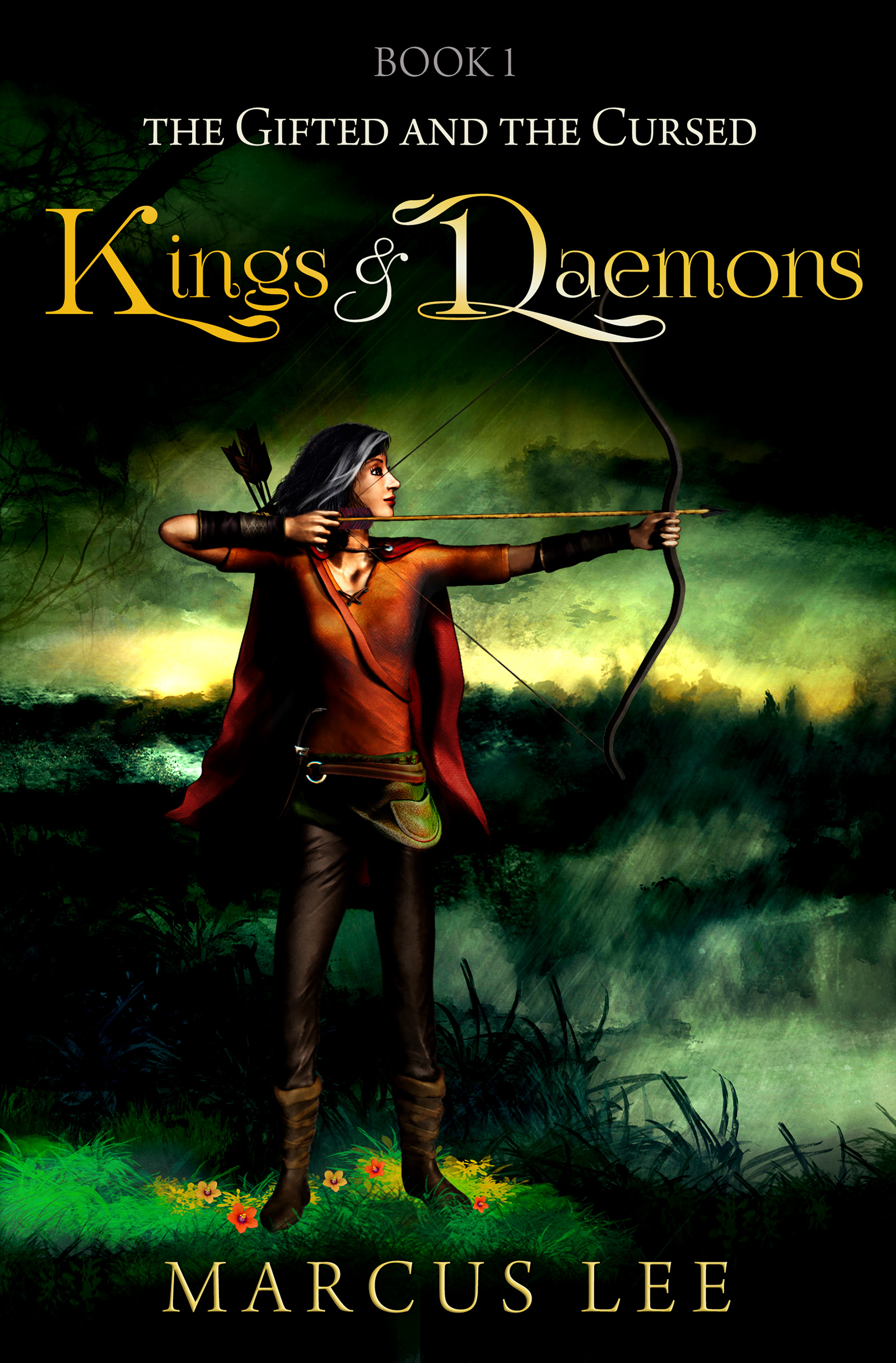


A tale of conquest, dark kings, and daemonic heroes. A spellbinding story that will enchant you with its plot of ambition, love, betrayal, sacrifice and redemption.


Over fifty years have passed since Daleth the seemingly immortal Witch-King and his army conquered the Ember Kingdom.


Now, with the once fertile lands and its enslaved people dying around him, the Witch-King, driven by his insatiable thirst for eternal youth, prepares his forces to march on the prosperous neighbouring Freestates. It will be the beginnings of a conquest that could destroy nations, bringing death and destruction on an unimaginable scale.


Then, when a peasant huntress whose rare gift was concealed from birth is exposed, it sets in motion a chain of events that could alter the destiny of generations to come.


Kings and Daemons is the first book in 'The gifted and the cursed' trilogy.


Excerpt


Taran awoke with a start, feeling strangely refreshed. Light filtered through the trees, and he sat upright. Rakan sat opposite him, smiling.


‘You needed the sleep,’ Rakan said gruffly. ‘You youngsters have no stamina.’


Taran turned his head to see Maya already up, readying a brief breakfast from the last night’s leftovers, and he felt a little disappointed he’d not awoken to find her sleeping next to him. She came over and gave him a large leaf full of meat, fruits and roots.


‘Hey,’ said Rakan. ‘How comes he gets so much this morning?’


Maya scowled down at Taran. ‘I think If he snores like a bear, he should eat like one too.’ But the kind smile in her eyes offset the words. She ruffled Taran’s hair gently as she walked past to give Rakan his breakfast. ‘Don’t worry, there’s plenty for you too. I feel so very safe protected by two of the wildest animals in the forest; a wolf and a bear,’ and she laughed merrily as she sat down to join them.


They ate in silence, although Taran thought, sitting next to Rakan when he ate was hardly silent. How could someone eat so noisily?


‘Right, I’m going to take Taran here as my bodyguard while we get some water,’ announced Maya, and she rose, sweeping up the water skins, leaving Taran to get to his feet quickly to catch up with her.


Taran looked briefly at Rakan.


Rakan smiled back at him. ‘Go on lad. I’ll break camp. You look after the girl.’


Hmmm, thought Taran as he hurried after Maya, ‘bodyguard,’ and liked the sound of the title. As Maya led him swiftly up and down small inclines through the trees, what amazed Taran was Maya’s unerring sense of direction. She moved through woodland, that to Taran looked the same in every direction, with confidence and purpose as though she’d travelled this way a hundred times before. However, as time passed, Taran briefly considered whether she was lost; but any doubts fled when they crested a small rocky rise.


There below them was a spring-fed pool with water trickling down a rock face, to gather in the hollow below. It was a large pool that no doubt had once provided life to many of the woodland animals.


‘Oh my,’ exclaimed Taran, holding his nose. The water was now green with slime as were the rocks, and the smell of wet wood, the foul water, and rotting vegetation was overwhelming. Taran stood a little shocked, then realised Maya must be testing him. ‘We can’t drink this. I’m no woodsman, but this will make us sick if not kill us. We’d be better off just eating berries than taking a sip of this. Now, where is the drinking water that you found, is it nearby?’


Maya laughed, and Taran thought it sounded like sweet music as she turned to him. ‘Taran,’ she said, and leaned in close, taking his arm. ‘Do you trust me?’


Taran paused, thinking for a moment, not wanting to give a glib answer, yet realised with surprise that despite hardly knowing Maya, he did trust her. Without even knowing why at the time, he’d opened up, voicing all the painful secrets locked away inside, and then she’d reciprocated. Something was growing between them, and he wanted it to grow more.


‘Well, do you?’ she prompted, a little frown of impatience at his delay caused a small furrow of grime to appear between her eyes.


Taran nodded, and was relieved to see the furrow, even if not the grime disappear.


‘Well then,’ Maya said, smiling again. ‘Close your eyes and promise not to open them until I say so.’


‘I promise,’ agreed Taran, doing as instructed, and reached out a hand to steady himself against a tree.


He barely heard Maya as she moved away and was tempted to peek. Yet a promise was a promise, and Taran knew in his heart that he never wanted to break one with Maya, so he carefully lowered himself to the ground, eyes closed.


Maya was a consummate hunter, and if it weren’t for her gentle humming and soft singing, he wouldn’t have known she was mere steps away, such was the softness of her tread. Her musical voice lulled him, and the smell of the decay that had seemed sickly sweet now seemed a heady perfume instead, and he found himself drift toward sleep.


‘Are you seriously snoring?’ asked Maya, a hint of annoyance in her voice.


Taran just caught himself from opening his eyes and shook his head. ‘No. Sleeping, me, never. Not while I’m guarding your body!’


Maya’s voice and breath were suddenly close to his ear, and it tickled softly. ‘Well then, as you are not asleep my prince, open your eyes and see.’


Taran opened his eyes, closed them, and opened them again. ‘Truly you are gifted by the gods to have such a power,’ he said, then stood slowly, gazing down at the scene below.


The foul-smelling pool was now pure and clear, no sign of corruption whatsoever. The water trickling down the rocks sparkled like crystal even in the dim light, over vibrant moss which had white flowers sprinkled throughout. All around the banks of the pool, grass now grew, and healthy bushes with verdant leaves flourished everywhere. Even the tree upon which he’d leaned stood firm, and the scent of freshness filled the air to replace the smell of decay.


‘Now, be a good bodyguard and help fill the skins!’ Maya laughed, as she tossed some to him, and they both moved down to the water’s edge.


Taran knelt next to Maya as they held the skins under the surface. As Taran filled the last one, he held up a hand.


Maya looked at him, enquiringly. ‘What’s wrong?’


‘The smell of decay is back.’ Taran cupped some water in his hand and brought it to his face and sniffed. ‘Something smells very wrong.’


A worried look crossed Maya’s face. ‘Really?’ she asked, and bent forward to scoop some water in her hand.


As she did, Taran leaned over, placed his hand between her shoulder blades and pushed her into the pool. She came up spluttering and screeching in indignation.


‘Now,’ said Taran, sniffing the air. ‘That’s a little better. But it’s going to take more than a small dip to get you clean,’ and reaching forward, he put his hand on Maya’s head, and gently pushed down.


‘Don’t you dare!’ she laughed, reaching up to push his hand away, but suddenly she grabbed his arm instead, and pulled him in.


As he came up coughing out water, Maya sniffed the air. ‘Now, that’s a lot better!’ and they both laughed as they splashed one another.


‘Oh my,’ said Maya. ‘It’s been so long since I was clean, and you too by the looks of it. Let’s clean up.’ She reached to the bank and pulled two small plants from the soil and gave one to Taran.


‘What am I supposed to do with this?’ asked Taran, wondering if he should eat it, then started to put it in his mouth.


Maya laughed. ‘Don’t eat it. Now watch.’ With that, she broke the stem and squeezed, so that the pulp oozed into the palm of her hand. She put the rest of the plant on a rock, then rubbed her hands together, producing a sweet-smelling lather that she scrubbed onto her face. She splashed water over herself shortly after, then dropped her hands. ‘See?’


Taran recoiled in horror. ‘What have you done to yourself!’


Maya’s hands swept up to her face, questing. ‘What do you mean?’ she asked, worried.


‘You’ve made a clean spot.’ Taran winked. ‘Now you’re now going to have to work on the rest. Maybe you’ll freshen up quite nicely given a lot of work.’


Maya wrinkled her nose at him, and carried on scrubbing, as Taran started to follow suit.


As they washed, she watched Taran out of the corner of her eye and had to admit to herself that she liked him a lot. She’d never been friends with a boy in her village, or anyone at all for that matter, staying far removed in case anyone discovered her gift. Yet here they were, sharing a cleansing, and she felt something was growing between them.


He wasn’t the best looking man she’d ever laid eyes on, but his humour, his voice, his kindness, and not forgetting the fact he’d been about to die for her, created feelings she’d never previously experienced.


She watched as Taran pulled his shirt over his head. Now there was another reason to like him, those broad shoulders and muscular arms.


Taran started to wash his shirt, and Maya realised that if she just washed herself, she would still smell.


‘Time to guard my body while looking in the other direction,’ she commanded, then ushered him to do an about-face. She took off her top, enjoying the feel of the cool water lapping against her bare flesh, then hesitated a moment before slipping out of her leggings. She turned her back on Taran as he started doing the same.


They washed fast then, and Maya sighed as she realised they needed to hurry. After putting her wet clothes back on with difficulty, she turned around to see Taran already clothed with a silly smile on his face. Maya felt her face burn bright red. ‘How long were you looking?’ she demanded, her eyes flashing.


Taran laughed, ‘For about as long as a piece of twine, maybe short, maybe long. What is it about women that they take so long to wash?’


‘Yooooou!’ hissed Maya, splashing Taran.


Taran reached out with his hands gently taking her shoulders. ‘Do you trust me?’ he asked.


Maya laughed, recognising her own words. ‘Let me think. Do I trust the man who pushed me headfirst into a pool, and who sneaked a look behind my back? I’m not sure!’


She saw the beginnings of hurt in his eyes and decided not to tease him anymore, not just now anyway. ‘Yes, I trust you.’


‘Well then, turn around and close your eyes,’ said Taran. ‘Don’t open them until I tell you to.’


Maya turned around in the water, and Taran’s strong hands encouraged her to lean back against him. She lay her head back on his chest and felt his heart beating powerfully.


Taran’s voice was soft and close to her ear as he said. ‘You seemed to have washed almost everywhere, and I do mean everywhere because I checked, but you forgot to wash your hair.’


With that, she felt his fingers start to massage the fragrant pulp carefully into her scalp. Had her eyes been open at that stage, they would have closed anyway, for the feeling was so soothing that she wanted to purr like a cat.


As Taran washed her hair, he told her a tale from his youth. The sound of his voice, the rhythm of his hands, the fragrance of the plant all relaxed her so much that she slipped into a light sleep. A short time later, Maya opened her eyes to see Taran’s face looking down on her.


‘If I snore like a bear,’ he said, eyes twinkling, ‘then, you snuffle like a piglet.’


‘A piglet!’ Maya exclaimed in indignation. ‘A piglet?’


Taran nodded. ‘I don’t know if you realise this, but I rather like piglets.’


Maya found herself unable to meet Taran’s gaze. ‘I rather like bears too,’ she whispered.


Maya stood up, turning slowly in Taran’s arms. They were so close that their noses almost touched, and she could feel his warm sweet breath on her face.


His hands moved to the back of her neck as he looked into her eyes, and Maya felt her insides flutter as if suddenly filled with a thousand butterflies. She leaned forward on tiptoes, and her lips found his, her eyes closed, as she wished the moment would last forever.


Pick up your copy of

Kings and Daemons

Amazon UK • Amazon US


Marcus Lee


Hi there, good to meet you all. I’m Marcus Lee, author of Kings and Daemons, the first in ‘The gifted and the cursed’ trilogy.


This is no doubt where I should have a real picture of me, or tell you how old I am, what my cat's name is etc. Instead, for now, I shall remain mysterious to those who don't know me.  For those who do, I'm probably still mysterious.​


Writing hasn't always been a serious hobby for me ... but it has always been there, lurking in the shadows, serving me well when called upon.


As I look back over the years, I realise I was guilty of writing many short stories, as well as poetry, and I'd like to think, that even if they were never intended to be published, they were nonetheless warmly received by the intended recipients.


Then in 2019, I was inspired to write not just a short story, or poetry, but a book. Then, suddenly, one book turned into a trilogy and a labour of love, and it was a love I wanted to share with the world.


So, here we are. The pandemic that put my career in sport on hold also gave me the opportunity to lavish time on my alternative hobby, or if demand dictates my new career.


However, only you, the reader, will decide whether this trilogy, which is still a work in progress, will be the first of many. I genuinely hope so.


Who knows, now these creatives juices are flowing, I might just keep on writing anyway.


Epic fantasy has been my favourite genre since I first read The Odyssey and The Illiad as a seven-year-old. Now it's my turn to see if I can bring another world to life in the imagination of others.


Connect with Marcus:

Website • Twitter • Facebook.


Join me in conversation with #HistoricalFiction author, John Pilkington #Interview @_JohnPilkington @SharpeBooks


A Conversation with

 John Pilkington


Please give a warm Coffee Pot welcome to Historical Fiction author, John Pilkington.


Mary Anne: Hi, John, I am so excited that you dropped by today for a chat. As a skilled writer for radio, stage and television what drew you towards writing historical fiction?


John Pilkington: In fact I wrote my first historical mystery before I wrote for television. Around twenty years ago my playwriting work seemed to be drying up, and I needed a new outlet. While on holiday, sitting by the pool day-dreaming, I got the idea of creating an Elizabethan-era sleuth. This was a period I knew well, having come to it through drama and literature (Shakespeare, Marlowe, Ben Jonson and the rest) before I got interested in the historical and social background. Somehow – I’m not sure how - Thomas the Falconer was born: a sharp-eyed man of the Berkshire Downs, servant to a wealthy knight, who could travel with his master, mix with people of many types and get involved in various mysteries. His first book, The Ruffler’s Child, was written quite quickly in 2-3 months, and through that I found a new agent who then, purely for financial reasons, lined up television work for me. I spent three years working on a BBC daytime soap, but didn’t enjoy it much. Fortunately the scripts could be done within a month, leaving me free to get back to the far more satisfying world of Thomas the Falconer. Though I had no idea then that he would become the hero of 7 books, let alone that I would go on to write 3 more historical series! Nowadays I rarely do any other sort of writing and am happy to spend my working hours in the Tudor and Stuart eras, which never cease to produce new stories.


Mary Anne: Your new book, Legacy: A Justice Belstrang Mystery takes place just 11 years after the infamous Gunpowder Plot. What were the challenges you faced in researching this period of history and were there any unexpected surprises?


John Pilkington: I’ve always been fascinated by the Gunpowder Plot, and became interested in those turbulent years during which the Tudor century gave way to the Stuart, after James 1st succeeded Elizabeth in 1603. It falls between two very well-trodden periods – the Tudor Age and the English Civil War - but is filled with conflict, intrigue and incident. I’m surprised that more writers don’t choose to explore it, because there’s a wealth of material there once you start delving into it.


 London in 1616 by Dutch engraver Claes Jan Visscher.


In 2014, I’d just finished a 2-year stint as a Writing Fellow at the University of Bristol, and was free to get involved in some new, in-depth research. I spent around 3 years researching the Jacobean era. As with any period, there are delights and disappointments. For one thing, I found King James an unpleasant man and grew to dislike him intensely. I could well understand why Catholics were so dismayed and angry when (like many a politician) he promised so much before his coronation, then turned his back on them after becoming King. Soon I began to identify with the plotters! I forget who it was who said that the writer should take the part of the underdog, but I often seem to do that instinctively that in my fiction.


Gunpowder Plotters by Crispijn van de Passe.


Surprises – yes, there were some. For example, I couldn’t get the grisly image out of my head of King James standing up to his bare ankles in the blood of a fresh-killed stag, believing it a cure for gout (I used it in Legacy). I was surprised by Guy Fawkes, the ‘warrior-monk’ who could move about freely because he was all but unknown in England, having spent ten years fighting for the Catholic cause on the continent. He was so tough that, after being captured, he withstood two days of torture before he would even reveal his true name. And when he came to be hanged, he was too weak to climb the scaffold unaided, yet threw himself off the top rung of the ladder so that his neck broke, thereby sparing himself the unthinkable agonies of being disembowelled and emasculated alive, like his fellow plotters. But perhaps the biggest revelation of all – though with hindsight, I should have expected it – was how paranoid the country was after the plot of November 1605 was thwarted, and how many Catholics were persecuted, jailed and ruined. Small wonder that the slightest mishap to the King or any of the Royal Family could easily be – and often was - interpreted as another attempted ‘plot’. Fertile ground - and out of this Legacy emerged. For authors, the ‘what if’ factor is often a useful spur. ‘What if someone had decided to…?’ We can speculate as we like.


Mary Anne: The hero of your new book, Robert Belstrang, is a retired magistrate who has turned his hand to investigation when the son of a neighbour goes missing. What do you think makes him such a good protagonist?


John Pilkington: I really wanted to find a different sort of sleuth, following the 4 I’d already created. Thomas the Falconer is a plain-speaking countryman – courageous, upright and loyal. Martin Marbeck, the protagonist of a series of 4 books, is more dangerous: a spy, swordsman and man of action. Boy actor Ben Button followed, the young hero of my Elizabethan Mysteries series for children. After that came my only female protagonist, Restoration-actress-turned sleuth Betsy Brand, who has featured in two mysteries so far, set in the 1670s (After the Fire and The Judas Blade).


Robert Belstrang arrived for a number of reasons (one of them is my growing older!). I thought a more learned man, a lawyer by training, principled but with a rebellious streak, could go places the others couldn’t – even into Whitehall Palace, seat of government as well as a place of intrigue and corruption. He’s a widower and a grandfather with a good deal of life experience as well as a wry sense of humour, and unafraid to admit his faults. He’s immune to bribes, as he is (usually) to the temptations of the flesh. He may not wield a sword like Marbeck, handle himself in a fist-fight like Thomas, or have the acting skills and female perceptions of Betsy Brand, yet he’s brave, believes firmly in justice and will pursue a trail to its bitter end. I can’t help thinking he has a touch of Inspector Morse, with his eye for detail and his grouchiness, as well as of Samuel Pepys, who generally lived life to the full. I began to write Robert’s narrative in the first person, a new venture for me, and at once felt comfortable with him.


Mary Anne: What do you think is the most challenging aspect of writing Historical Fiction?


John Pilkington: I think it’s getting the balance right, between creating a believable historical setting and telling a strong story that makes the reader want to stay with it.


There are pitfalls, like allowing your characters to express 21st-century views - or trying to reproduce period dialogue, which is difficult and sometimes downright impossible. Then, readers can soon tell if you’re trying too hard to sound ‘authentic’, for example by putting in unnecessary historical detail to prove you’ve done your research (I’ve fallen into that trap myself!). They can also grow bored if the characters are too much ‘of their time’ and difficult to identify with – for example the deep, unquestioning religious beliefs of the 16th and 17th centuries, which can lead people to behave in ways we find hard to understand. But they do appreciate a strong sense of ‘being there’.


My usual method is to choose a particular time in which to set my story, then research the events of that year, or years, so that I won’t make any glaring mistakes – like including a real-life character who had in fact died previously, which almost happened once. I build my fictional mystery against this background, even interweaving events if possible, so that the story could – just feasibly – have happened then and there. Legacy is rooted in the events, attitudes and ambience of 1615-1616, and I had to be careful with my timing - for example, finding out when the King was away hunting, as he often was, rather than at Whitehall, which involved digging into various records. I think taking such pains pays off, in the end.


Mary Anne: What advice do you have for aspiring Historical Fiction authors?


John Pilkington: Firstly, I think you need to be passionate about your period. You will need to do plenty of background reading and research of course, and if you aren’t intrigued by what turns up you will get bored with it, which is fatal. What is it about a particular era which most attracts you? Maybe you were enthralled by films like Gladiator, Braveheart or Elizabeth, or drawn to Citizen Kane or even Brighton Rock – the 20th century is now a perfectly acceptable setting for Historical Fiction. Maybe you devoured books as a child set in the Middle Ages, the Civil War or the American Frontier. It doesn’t matter too much because, whatever period you choose, someone has already set a book in it (or twelve). Never let that put you off, but remember that certain periods of history have been plundered extensively by authors, from Ancient Egypt and Rome through the Middle Ages, Tudors and Stuarts, the Napoleonic era to both World Wars. Try to find a new angle if you can, and a protagonist unlike those who come easily to mind. Who, for example, would have thought that a herbalist monk based at an abbey in Shrewsbury in the 12th century would turn out to be such a successful sleuth, in print and on screen? But Ellis Peters’ Brother Cadfael remains popular today, almost 45 years after he first appeared.


I would suggest that, to begin with at least, you let your research lead you. Nowadays you can do a great deal of it online, though you will probably want to build up a library of good reference works on the period, rather than just a stack of Wikipedia print-outs. I’m also a great believer in ‘hands-on’ research when it’s possible. I don’t just mean visiting museums, castles, historic houses or battlefields, stimulating though these may be. I mean ‘getting your hands dirty’, as one of the best writers I knew used to put it: handling period artefacts if you can, inspecting everything from food to weapons, trying on clothes, talking to specialists and so on. I did some fencing at school, which has proved useful when writing sword-fighting scenes. For the Thomas the Falconer books I went on a falconry course, flew some of those remarkable birds myself and learned a huge amount from the falconers I met. Having done some acting as a student, and seen a few Restoration-era plays in the theatre, helped me enter Betsy Brand’s world. In short, anything that brings you closer to the period in which your characters live is useful.


I have a cork wall in my study on which I pin portraits, photographs, maps, quotations, snippets of dialogue – anything that helps with the work-on-progress. One you’ve settled on your central figure – hero, sleuth, or however you like to think of him or her – you can build up a profile before putting ‘X’ on the page. Is there a family? What does X do for a living? What does he/she care about most, and who are they likely to come up against?


Of course, I speak as an author of historical mysteries, and it could be that your protagonist isn’t an investigator or crime-solving figure at all. Some authors choose a real personage (soldier, politician, criminal, courtesan, nurse - there are no limits) and make them the centre of their novel. Who would argue with the success of Hilary Mantel’s portrayal of Thomas Cromwell, hitherto an unpopular and somewhat shadowy figure of the Tudor Court, and now the engrossing subject of a world-famous, prize-winning trilogy?


As I’ve said, it’s really down to what excites and intrigues you. You should do your research, build up your story/plot and then try out a few openings to see what works best, if it helps. Good luck!


Mary Anne: Thank you so much, John, for taking the time to chat with us today.


If you would like to find out more about John and his books then you know what to do SCROLL DOWN!


Legacy

A Justice Belstrang Mystery

By John Pilkington


1616

Robert Belstrang, ex-magistrate bored with country life, comes to London to investigate the strange disappearance of Thomas Jessop, son of a poor Catholic neighbour. He locates the youth in Bedlam asylum, silent and starving himself. When he tries to free Jessop, he is warned off the case by a politic lawyer, Anstis. Soon after, Belstrang finds himself drugged, robbed and falsely imprisoned.

Once released Belstrang persists in his investigation, but he is thwarted at every turn: unseen forces are at work who seemingly want Thomas Jessop to die. When Belstrang confronts Anstis, even he turns up dead.

The trail grows murkier by the hour, drawing Belstrang into the fear-ridden Catholic underworld - until he uncovers a plan with its roots in the Gunpowder Plot of more than a decade ago. Young Thomas, an embittered papist, was being used in a desperate scheme to mark the anniversary of the Plot. The scheme failed – and now the conspirators seem eager to cover up the whole business.

But Belstrang’s a stubborn man. With the help of ex-soldier Daniel Oldrigg, he sticks doggedly to his purpose - and stumbles on the real causes of the Anniversary Plot, which stem from the very heart of a corrupt government.

Belstrang must uncover the truth, or die trying.


Pick up your copy of

Legacy: A Justice Belstrang Mystery

Amazon UK • Amazon US

Add Legacy: A Justice Belstrang Mystery to your ‘to-read’ list on

Goodreads


John Pilkington


Having given up trying to become a rock star after playing guitar in various bands, John Pilkington turned to writing and found his true vocation. His first works were radio plays, followed by stage plays and scripts for BBC television. But his venture into historical fiction proved crucial, and it continues to be his lifelong passion. He has published around twenty books including seven in the Elizabethan-set Thomas the Falconer Mysteries series (now republished by Sharpe Books), four in the Marbeck spy series (Severn House), and two in a Restoration-era series featuring actress-turned-sleuth Betsy Brand (Joffe Books). His latest novel is Legacy (Sharpe), set in the aftermath of the Gunpowder Plot.


Born in the north-west of England, he now lives in a quiet estuary village in Devon with his partner, and has a son who is a musician, composer and trainee psychologist. When not at his desk he may be found walking by the river, doing a little carpentry or listening to music - and reading, of course. Having moved his fiction into the 17th century, he quite likes it and may well remain there.


Connect with John:

Website • Twitter • Goodreads.


Check out Ron L. Lahr's fabulous #NewRelease — The Children of Kathaldi: The Kathaldi Chronicles Book 1 #Fantasy #GreatReads @LahrRon


The Children of Kathaldi

The Kathaldi Chronicles Book 1

By Ron L. Lahr


The Kathaldi Chronicles are an epic tale of a long forgotten evil that has returned to conquer the world. 


The Kathaldi hate the gods. The gods are afraid of the Kathaldi. The last time they tangled most of the world was destroyed.

The only hope is a small group of friends. Join Dirk as he tells their story. Who is Dirk?

He's a thief. And a scoundrel. Now he needs to help his boyhood friend save the world.

Some wonder why Dirk would help. Look, he’s a jerk, not a monster.

And if the world is destroyed who would Dirk steal from?

Does that make him a hero? Hopefully, the ladies will think so.

There is adventure, heroes aplenty, magic, monsters, evil deeds, and lots of laughs as Dirk tells how he saved the world while his friends were nearby.


Excerpt


Chapter 1 – The Beginning

Look, I’m not writing this to feed my ego. Or to get free drinks, or have ladies throw themselves at me. I’m sure that will all happen, but it’s not why I am doing this. This is for my children. I want them to know me and what I accomplished. What I was a part of. A big, significant, important, part of.

Unfortunately, I don’t know exactly who my children are but, mathematically, I figure I must have a bunch of them. This way, I don’t have to track them down individually and talk to them face to face. It’s a big time-saver for me. Great idea, right? As you read this you’ll see that I’m kind of an ideas guy.

So, to start off you should know that before the important events in this book took place I had some trouble with the authorities from time to time. I would not exactly say I was a thief, but that’s because thievery has a pretty bad reputation. A lot of other people did describe me that way, and I admit that it was accurate.

But, before I get too far ahead of myself I suppose I should step back a little, just to the beginning. My beginning. I was born. I was named Dirk because my father had to sell his favorite one to pay the midwife when I was born, and he wanted me to remember it. He liked reminding me of what they had to give up for me just to pop out of my mother. They were pleasant like that. "It was a difficult birth," my mother would often say. "And it ain't gotten any easier since!" They would both say that last part together, if they could. It never got old. Seriously. Never. Still funny. It's hard to say who I got my own awesome sense of humor from because they were both so darned hilarious. 

At some point my dad left so my mom had to finish raising me and my siblings on her own. It didn’t bother me. And if it did, I am completely over it. It’s not a big deal. The important, relevant, part is that I had a friend. And not just that I had a friend, but who he was.

Thilos. He was an orphan who was being raised by a crippled friend of the family who actually turned out to be a good guy. One of the best. See, not all cripples are awful. Anyway, not your normal, unhappy, sad, orphan story. It’s kind of sweet, really.

Anyway, we met as kids, running around the streets, playing, having fun, and maybe causing a little bit of trouble. He taught me to fight and also how to read. Neither very well, mind you, we both needed other, better, teachers later on. But I might never have learned how to read if my new friend hadn't convinced me how cool it would be. I'm not sure he was right about that, it's never gotten me any women, but I’ll admit that it has been extremely helpful.

The really important and relevant part is that we were still friends when the events in this book began, which is why he looked me up that day when he was in big trouble. By the way, this is not supposed to be some fancy foreshadowing – like we are enemies now, or something - it is just me trying to manage what to say and when to say it in terms of the present and the future. It’s kind of tricky. I don’t want to give things away too soon, or too late, or too never. I’m just a guy, trying to tell an amazing story, while some people judge me for every single fricking thing I do.

Chapter 2 – The Actual Beginning

I know what you’re thinking – that was a whole chapter? Well, write your own damn book. I am telling this story and the stuff in the first chapter wasn’t really a part of the main story that starts pretty soon here in this chapter, so I decided to make it its own thing and have the actual story start now, in chapter two. Happy? Unhappy? Great, because I don’t care. As far as I know you’re reading this a million years in the future and I’ve been dead for most of that time.

Anyway, one day I was relaxing at home in my place in Ansdron, one of the northern border cities, when there were a series of loud knocks on my door. I answered it carefully, because people can misunderstand things that you do, you know? Judge you for your past actions, I mean. But it was my old friend Thilos, looking out of breath and worried. I invited him in, or at least I started to, but he pushed right past me and quickly closed the door.

“Sorry to be rude, Dirk,” he said as he moved to the window and pulled the curtains closed, “but I’m being followed.”

I quickly slid up to a different window and used the large dagger suddenly in my hand to push just enough of the curtain aside that I could see the normal looking street scene outside as I asked, “Who is following you, Thilos?”

He sighed as he sat down on one of my comfortable, yet tasteful, chairs. “I don’t know if they’re actually following me right now, I think I lost them. But they are definitely after me.”

“Who?” I was getting a little frustrated which usually leads me to single word sentences.

Thilos shrugged with a slight smile. “The Warders.” He sounded a little embarrassed.

At this point I was quite confused. “The King’s Warders? As in Thilos, the King’s Warder?” Thilos had been a King’s Warder for almost seven years. It was all he had ever wanted to do, serve guarding and patrolling the borders, just like his parents and his guardian had done. He had joined as soon as he turned sixteen and qualified. So, saying the Warders were following him was like saying his parents were trying to kill him. Crazy!

He nodded, as if relieved I was following his insane logic. “That’s right!” He looked from side to side, apparently checking for eavesdroppers, inside my home, and lowered his voice to a whisper, “I think they’ve been infiltrated by the Kathaldi.”

Now, you readers already know what happened over the next few years but that’s because you live in whatever is the present for you. I lived in the present for me, which is the past (or even the distant past – I don’t know) for you. Suffice it to say that for me, in the ‘at the time present’, no one had heard of the Kathaldi being alive for centuries. So, this stuff Thilos was saying, even though he is a great guy and my oldest friend, sounded crazy as could be. I looked him over carefully but he didn’t look any different. Same brown hair and eyes. Same healthy looking grey skin. Still wearing the same old grey Warder’s uniform. He looked sane, I guess.

Before I continue with the story I guess I should take into account the fact that the kind of women I am most attracted to aren’t always that smart. So, maybe some of my kids, or grandkids, or their kids, or their spouses, or whoever else is reading this, are some kind of idiots and don’t know who the Kathaldi are, or were, or whatever. So, I’ll tell you, as quickly as possible so we can get back to my story. My awesome, heroic story. Dang, if some of you are really that dumb maybe you didn’t even know about the Kathaldi coming back and I just ruined the book for you. Oh well, you’ll probably forget about it soon. Man, I love dumb people! They make for the perfect audience.

Okay. So, in the olden timey days almost everyone lived quite a ways north of where we live now, and by that, I mean north of Ansdron, which is one of the most northern cities these days. There were supposedly a bunch of islands where everyone lived happy lives, enjoying the sunny beaches. That is, until the Kathaldi, who lived on just one of these islands, started stirring up some stuff.


Pick up your copy of

The Children of Kathaldi

Amazon UK • Amazon US


Ron L. Lahr


Born in the San Francisco Bay area but raised in Spokane, Washington, Ron L. Lahr is the author of the new epic fantasy series the Kathaldi Chronicles. He has worked mainly in the IT and ERP software consulting fields and enjoys gardening, cooking and baking from scratch with his amazing wife, working on old cars and spending time with his family, which mainly consists of his wife, children, parents and in-laws, plus of course, all of their pets. He is also a fan of the Gonzaga men's and women's basketball teams and the Seattle Mariners.

Connect with Ron: Facebook • Twitter.